
The Challenge of Building Greenfield Infrastructure
This case study follows a newly established water utility organization tasked with building an entire water network from scratch in a remote region. From desalination plants and pumping stations to meters, pipelines, and control systems, every component had to be designed and delivered within tight timelines. As construction accelerated, teams produced information in different formats such as engineering drawings, project files, integration sheets, operational documents, and vendor‑supplied data which in turn created fragmented views of the truth.
The organization needed a single architectural backbone to map, align, and govern its rapidly growing ecosystem. Sparx Systems Enterprise Architect and Prolaborate, together with the Sparx APM Accelerator, became the foundation for creating that unified model by capturing every asset, system, and decision in one place to support traceability, governance, and the early stages of their digital twin.
Turn static models into actionable insights. See firsthand how to visualize application lifecycles, costs, and risks in real-time with the Sparx Systems Architecture Platform.
Sparx EA APM Model as the Foundation for Conceptual Traceability
Very early in the journey, the organization realized it needed a unified model to bring together the core building blocks of the ecosystem:
- Business capabilities and operating functions
- Physical water assets from plants and pump stations to meters and reservoirs
- Applications such as SCADA, EAM, ERP, and customer systems
- Data, integrations, and information flows
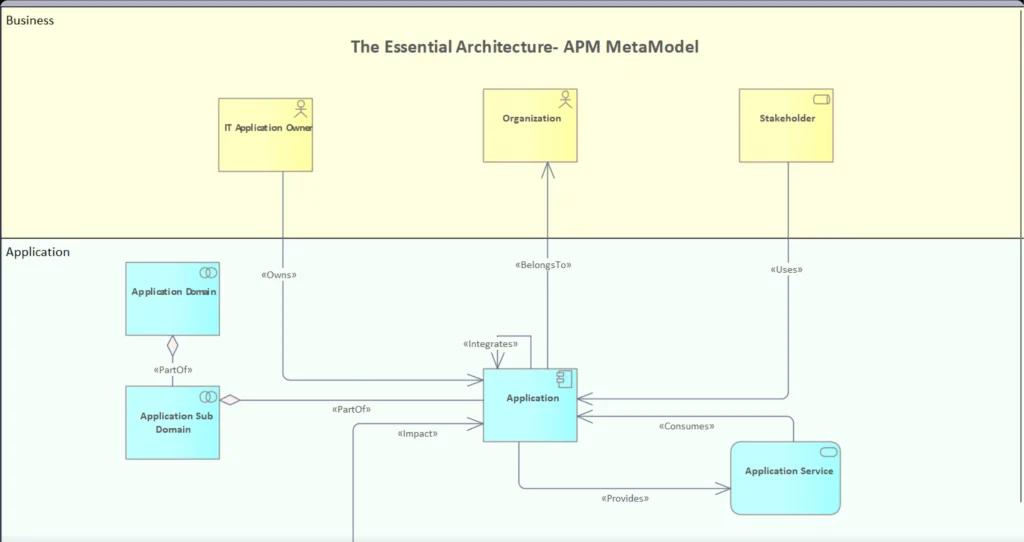
The Essential Architecture APM Metamodel Template from Sparx Systems Enterprise Architect
Rather than trying to invent a modeling approach from scratch, the team adopted the APM Accelerator and TEA framework. This provided metamodels, MDG configurations, and import templates that ensured consistency right from day one.
This meant that as construction progressed and more systems came online, everything could be placed into a common structure. Over time, Sparx EA evolved into the authoritative conceptual source of truth for the organization and its broader enterprise architecture practice.
From TOGAF to a Digital Asset Layer
To keep the model structured and scalable, the team followed a TOGAF-aligned architecture approach, supported by ArchiMate as the common notation. This helped create a clear flow from Business Architecture down to Application, Technology, and ultimately the physical asset layer.
The metamodel was then extended for water-specific components such as:
- Desalination and treatment plants
- Pumping stations and pressure management zones
- Transmission and distribution mains
- Storage reservoirs and tanks
- Meters, telemetry devices, and IoT sensors
By linking these physical assets back to applications, integrations, and data, the team essentially created a digital representation of how the real-world network operates through a functional digital twin.
Organizing Around Stable Capabilities
One of the most important choices was organizing the enterprise model around the Business Capability Model (BCM). Unlike organization structures which change frequently, capabilities represent the inherent functions of a water organization.
These include areas such as:
- Water production and treatment
- Network operations and control
- Asset lifecycle management
- Metering and customer operations
Using capabilities as the primary organizing lens allowed teams to quickly understand which assets and applications supported each part of the value chain. It also made investment planning far easier because everything was tied back to a stable, business-driven structure.
Ensuring End-to-End Asset Traceability
Once the structure was in place, the focus shifted toward making traceability a practical everyday mechanism, not an abstract architecture concept.

Illustrative capability map showing how operational functions in a water-management domain are organized to support conceptual traceability within Sparx EA.
Using the predefined APM relationships and a structured application inventory in Sparx EA, the team mapped:
- Assets to applications
- Applications to functional domains
- Applications to projects and integrations
- Systems to stakeholders and owners
With this, impact analysis became a built-in capability.
Automating Engineering and Review Traceability
Consider a scenario: a pumping station is being upgraded, or a pipeline section needs to be replaced. Using EA, engineers and architects could immediately identify:
- SCADA functions linked to that asset
- Interfaces dependent on its telemetry
- Data pipelines or dashboards using its readings
- Capabilities and processes influenced by its operation
The Accelerator’s integration diagrams and model add-ins helped generate viewpoints that visualized the “neighborhood” around each asset such as applications, integrations, and dependent processes.
This meant decisions were not made in isolation. Every change had a clear, traceable context.
Mapping Applications to Critical Domains
The introduction of a Domain Hierarchy Map gave the organization a structured lens for understanding its application landscape. Domains like Production, Network Operations, Asset Management, and Customer Service helped categorize applications based on function.
Combined with TIME assessments (Tolerate, Invest, Migrate, Eliminate), this allowed the organization to:
- Identify overlaps or redundancies
- Prioritize modernization and rationalization efforts
- Align application roadmaps with asset strategies
Instead of periodic spreadsheet-based reviews, application portfolio management became a continuous, model-driven practice.
Driving Governance and Communication
A model only has value if people can engage with it. This is where Prolaborate played a pivotal role.
By publishing curated stakeholder-specific APM dashboards and views, Prolaborate transformed the EA repository into a browser-based portal that executives, engineers, and planners could consume without needing to use Enterprise Architect directly.
Delivering Real-Time Visualizations to Stakeholders
Through Application Portfolio Management (APM) and TEA dashboards, the organization provided:
Executive insights such as:
- Portfolio composition by domain
- Risk, lifecycle, and investment highlight views
- Rationalization candidates through TIME
Operational and engineering insights including:

Prolaborate dashboard used to bring TOGAF-based capabilities, value streams, and process models into a cohesive digital asset architecture
- Zones with assets linked to applications and integrations
- Impact diagrams for critical plants and pump stations
- Traceability from physical assets to digital systems
Asset lifecycle visibility such as:

Prolaborate dashboard presenting capability and architecture transition roadmaps, providing real-time visibility into lifecycle status and planned changes across the portfolio
- Roadmaps outlining introduction, modification, and retirement
- Criticality, hosting, data classification, and security attributes
Because Prolaborate is always in sync with Sparx EA APM models, teams accessed live, approved, and up‑to‑date information by effectively browsing the digital twin seamlessly.
Start your APM journey. Learn the fundamentals of portfolio setup, defining risk categories, and building your first dashboards.
Sparx EA as the Accumulator of Knowledge for the Digital Twin
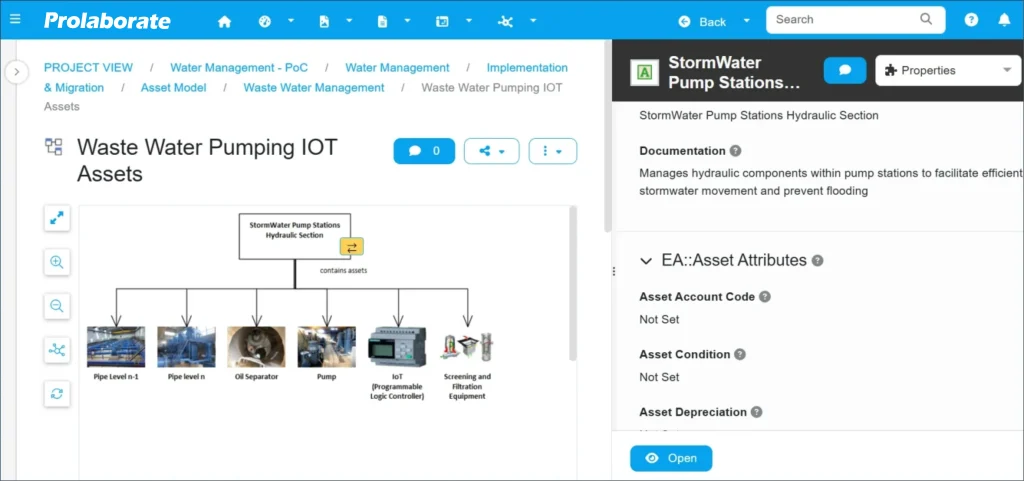
Prolaborate asset-model view showing hierarchical equipment relationships and metadata used to support the digital twin
When you bring Sparx EA, the TEA/APM Accelerator, and Prolaborate together, you get more than a set of tools—you get a structured way of thinking and governing. For this water management organization, the combination delivered:
- End-to-end conceptual traceability across all layers
- A practical digital twin connecting physical and digital components
- Stronger governance over assets, applications, and data
- A living repository that grows richer with every project and decision
In many ways, Sparx EA became the organization’s accumulator of conceptual knowledge. Every upgrade, new asset, change request, and integration enriched the model, strengthening the digital twin rather than scattering information across disconnected documents.
This is the kind of foundation that not only supports today’s operations but also positions the organization for smarter, more resilient water management in the years ahead.


