
Over the years, most organizations accumulate a large and complex software portfolio. Applications are added, but rarely is there a clear plan for retiring old, redundant, or obsolete ones. This is where application rationalization comes in.
It’s a methodical process for evaluating every application and making a deliberate decision: should we keep it, replace it, or retire it? The goal is to strike a balance between key factors, evaluating value vs. risk vs. cost, along with technical health.
A successful rationalization program simplifies the entire IT landscape and frees up resources for innovation. Without a structured approach, these decisions often become political, arbitrary, or based on subjective opinions. This article provides a clear, repeatable rationalization framework, outlining the standard rationalization steps from gathering the initial data to communicating the final plan, to make your rationalization effort objective and transparent.
Connect Stakeholders with Real Time Architecture Insights
Inputs: Inventory, Cost, Risk, Usage, and Technical Health
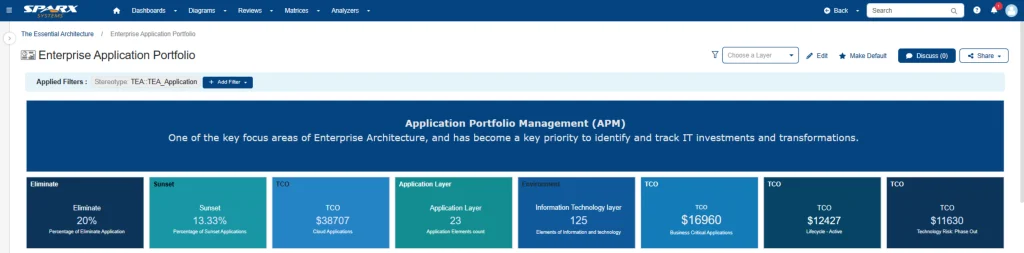
Objective scoring, a key part of any rationalization framework, is not possible without a comprehensive inventory. The first step is to build a solid, reliable dataset. The goal is not to document every single detail, but to collect a minimal viable dataset that allows for a fair, standardized comparison.
Inventory Attributes
- Name, description, owner, business domain, capabilities served, lifecycle status
- Hosting model (on-premises, private cloud, public cloud)
Cost Data
- Annual run costs: licensing, maintenance, support, infrastructure, third-party services
- Split CapEx vs. OpEx in partnership with finance
Risk Indicators
- Security vulnerabilities and controls coverage
- Compliance exposure and data sensitivity
- End of life (EOL) status for platforms and components
Usage Metrics
- Active users, transactions, or consumption measures
- Utilization vs. peak loads
Technical Health
- Technical debt, code quality, and alignment to standards
- Integration complexity and dependency footprint
How to gather: This information often lives in different places. You’ll need to pull from spreadsheets, connect to your CMDB, and query finance and security systems. Consistency is the most critical factor. Inconsistent data will lead to inaccurate scores that do not reflect the true state of the portfolio.
sheets or integrate CMDBs, finance systems, and security tooling into Enterprise Architect (via Pro Cloud Server). Capture data consistently so scoring reflects the true state of each application.
Scoring Model: Weights, Thresholds, and Tiebreakers
With your data collected, the scoring model translates that raw information into a clear, comparable score. It acts as a practical decision-making matrix, translating data into a decision.

Define Criteria and Weightings
- This is where you decide what matters most.
- Example: Cost (30%), Business Value (25%), Risk (25%), Technical Health (20%)
- A company in a highly regulated industry might give Risk a much higher weight. This is a common adjustment, as the weights must mirror the company’s strategic goals.
Establish Thresholds
- Define clear bands for each criterion (e.g., High / Medium / Low).
- Use specific numeric definitions (e.g., “High Risk” = 2+ unpatched critical vulnerabilities) so the scoring is consistent, no matter who is doing the assessment.
Normalize Scores
- Convert all these different inputs to a common scale, like 0–10.
- This allows you to combine them into a single, composite score for each application.
Apply Tiebreakers
- What happens if two apps have nearly identical scores? Have a tie-breaker ready.
- This could be strategic fit, customer satisfaction scores, or alignment with your target architecture.
Document and Share
- This scoring process must be transparent. Publish the scoring model and share concrete examples.
- Use graphs and charts to visualize the portfolio. This helps everyone understand the big picture and quickly identify the outliers that need immediate attention.
Disposition Options: Retire, Replace, Rehost, Replatform, Refactor, Retain

Once the scores are calculated, the next step is to assign a “disposition.” This is where the popular 5R model (or sometimes 6R) comes into play. A consistent set of these disposition options—the planned 5R/6R decisions for each application—is essential for guiding the actual work.
- Retire: Decommission apps that are redundant, low-value, or too risky. This involves planning data migration and clear user communication.
- Replace: Substitute the application with a better solution, whether that’s a new product or another tool you already own.
- Rehost (Lift & Shift): A common cloud-migration move. This involves moving the app to new infrastructure (like IaaS) without changing the underlying architecture.
- Replatform: This approach involves migrating the app and making minor changes to take advantage of a modern platform (like PaaS), but without a full rewrite.
- Refactor (Rearchitect): The most intensive option. This involves significantly redesigning the application, often to use cloud-native patterns and pay down major technical debt.
- Retain: In some cases, the best decision is to retain the application as-is, especially if its value is high and the cost/risk are acceptable. This decision should be coupled with any necessary improvement plans.
Wave Planning and Managing Dependency Risks
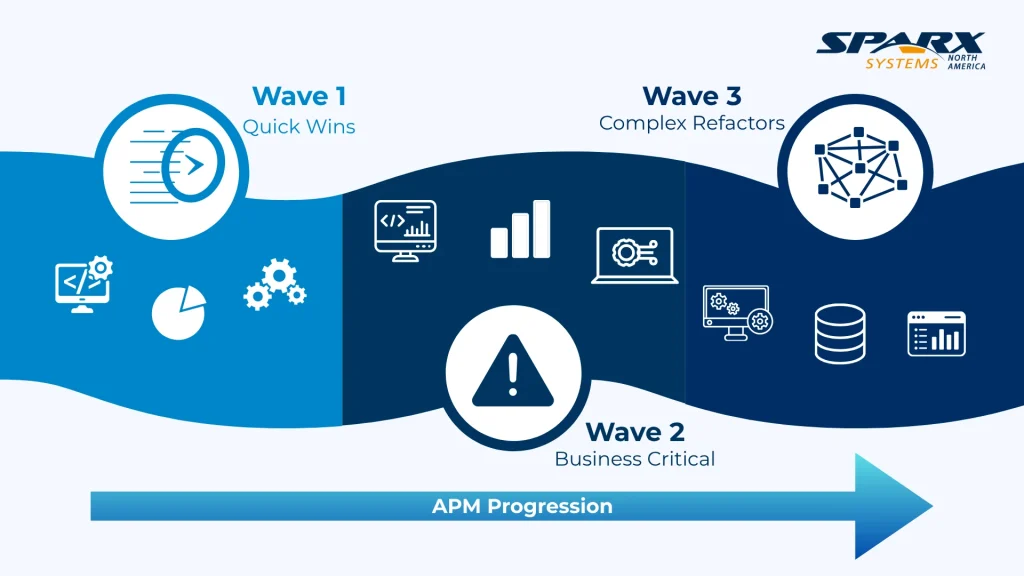
Trying to rationalize hundreds of applications at once is highly impractical and prone to failure. A phased approach, or “wave planning,” is critical for managing risk and not overwhelming your teams.
Plan in Waves
- Wave 1 (Quick Wins): Start with low-risk, high-savings targets. These are often unused or redundant apps. Completing this wave builds momentum and credibility for the program.
- Wave 2 (Business Critical): Move on to medium-complexity, high-value applications. These require more careful planning and solid rollback strategies.
- Wave 3 (Complex Refactors): Save the most complex, tightly coupled, and high-debt applications for last. These require the most effort and budget.
Analyze Dependencies
- Before modifying any application, it is crucial to understand its dependencies. Model the interfaces and data flows to identify all upstream and downstream systems. This analysis is what prevents you from accidentally breaking a critical business process.
- Accessing this dependency and inventory data in real-time is crucial for making informed decisions. This is where dedicated APM platforms become essential.
- For example, tools like Sparx Systems Enterprise Architect, when connected via Pro Cloud Server, can integrate with CMDBs, finance, and security systems. This allows you to store, visualize, and analyze your inventory, costs, and dependencies in one place, modeling data flows and seeing the impact of a potential change before it’s implemented.
Align with Other Initiatives
- IT programs rarely exist in isolation. Your rationalization plan should align with broader APM frameworks, standards, and best practices and coordinate with major cloud migrations, ERP upgrades, or M&A integrations to avoid resource conflicts and redundant work.
Track Progress
- Make your progress visible. Using visual dashboards for Application Portfolio Management allows you to track key milestones (‘migration complete’ or ‘retirement confirmed’) and high-level metrics like savings achieved and risk reduced.
Communicating Decisions to Executives and Teams
A rationalization plan that isn’t communicated clearly is unlikely to succeed. Stakeholders must understand the rationale behind the decisions.
Executive Summaries
- Leadership requires a concise summary, not the raw data. Provide the rationale for the decisions, the investment required, and the expected benefits (cost savings, risk reduction, etc.).
Team Workshops
- Conduct workshops with application and business teams. Walk them through the scoring, explain the planned dispositions, and—most importantly—gather their feedback. Their expertise is invaluable for spotting risks or opportunities you missed.
Publish Structured Artifacts
- Make the final decisions and plans accessible. This includes decision logs, detailed migration runbooks, and updated architecture diagrams. Tools like Enterprise Architect and Prolaborate are ideal for this, providing a “single source of truth” that teams can access for self-service.
Change Management
- This component addresses the impact on end-users. Prepare them with clear communications, FAQs, training for replacement tools, and dedicated support channels.
- When an application is successfully retired or replaced, recognize the achievement. Quantify the benefits and share the success with the organization.
Discuss your Application Portfolio Management Context, data sources, and governance goals with SSNA’s expert consultants.
Application rationalization is more than a simple clean-up exercise. It’s a strategic component of Application Portfolio Management (APM), transforming a costly, complex portfolio into a streamlined, efficient one that supports business objectives.
By following this rationalization framework helps you build on accurate data, a transparent scoring model, clear disposition options, and constant communication while removing subjectivity and politics from the process. The result is objective, sustainable decisions that achieve significant cost optimization through application rationalization, lower risk, and make space for real innovation.


