
Within a UK defense organization, architects regularly had to justify the purpose of architecture to stakeholders and customers. Much of the information about missions, systems and applications lived in analog documents, spreadsheets and PowerPoint slides, and the models themselves were often experienced as inaccessible, tangled architecture diagrams that stakeholders could not easily reach or understand.
Across the organization, information about systems, missions and applications lived in disconnected documents, spreadsheets, and PowerPoint decks. Different teams maintained their own artifacts, each valid in its own context, but there was no single, governed way to bring those perspectives together.
The architecture team wanted something different: a way for stakeholders to go to the model itself, treat it like a digital library, and interrogate it directly without needing to become experts in notations or tools. Using Sparx Systems Enterprise Architect together with Prolaborate, they set out to transform “architecture engagement” rather than just produce better diagrams.
Cut Months of Setup into Days—Start with Proven Sparx Application Portfolio Management Templates
I. Enforcing Model Governance and Eliminating Noise
From Documents to a Model‑Driven Backbone
One of the first shifts was mindset. Instead of treating Enterprise Architect as a drawing tool, the team treated it as a model‑driven backbone for defense information for integrating APM into wider enterprise architecture efforts as well.
Architects became, in their own words, more like back‑end developers: they assembled and maintained the model based on feedback from stakeholders and other subject‑matter experts, updating it to keep it current. The stakeholders, in turn, stopped interrogating slide decks and started interrogating the model and the views generated from it.

Sample Sparx Prolaborate landing page showing a NAF UAFP metamodel grid used to navigate standards-based architecture views
At the same time, the team was very deliberate about aligning to industry and defense standards. They referenced TOGAF, the NATO Architecture Framework and Unified Architecture Framework, and used ArchiMate where appropriate – but with a twist. Rather than expecting everyone to read notation‑heavy diagrams, they used those standards as a back‑end language and focused on what stakeholders actually needed to see.
A Standards‑Aligned MDG and Rich Sparx EA Diagrams
To make that work at scale, the team created a custom MDG profile in Enterprise Architect. This MDG captured the lexicon of elements and relationships they needed to describe platforms, capabilities, information flows and IT systems in a way that aligned with defense frameworks.

Essential APM architecture diagram illustrating how application owners, domains, and services connect to core applications
On top of that, they invested heavily in visual language. The MDG included an ever‑expanding catalog of graphics and icons, so that architects could rapidly build models and then present them as rich pictures instead of technical notation.
In practice, this meant:
- Using familiar iconography (including visuals that look like those seen in everyday slides) to represent key components.
- Decomposing the enterprise into understandable parts – from roles and facilities through to applications and services.
- Generating views that look like the operational and IT diagrams stakeholders are used to, while still being backed by a rigorous, standards‑based model.
This approach was critical to moving away from standalone documents and PowerPoint decks. Stakeholders could see visuals that made sense to them, while the architecture team retained a clean, governed model underneath.
II. Achieving Security and Relevance Through Role‑Specific Access
Keeping Sensitive Architecture On‑Premises
Because of the sensitive nature of defense architecture, the organization deliberately avoided a cloud deployment. Instead, they ran Enterprise Architect and Prolaborate on‑premises, keeping models and views inside a restricted, protected environment.
This gave them confidence to bring more of their real operational and IT landscape into the repository, including mission threads, platform information and application catalogs. The goal was not just documentation, but a single place where different parts of the defense enterprise could see how things connect.
Making Sparx EA Models User‑Friendly with Prolaborate
The second part of the equation was usability. Many of the stakeholders who needed access, including one‑ and two‑star officers, had neither the time nor the inclination to learn a modeling tool or a complex web interface.
To address this, the team configured Prolaborate so that it felt like a simple, icon‑based portal rather than a modeling tool, surfacing role-based APM stakeholder views that business and mission users could navigate with a few clicks:

An illustration of the User-friendly Prolaborate home screen presenting clickable icons for mission concepts, equipment, activities, applications, and requirements
- The Prolaborate landing page used a grid of intuitive icons, making it look and feel like an iPhone or Android home screen.
- Each icon led to a curated set of dashboards, diagrams or dynamic documents, for example, views of mission threads, IT systems or application landscapes.
- Non‑technical stakeholders could click into a graphic, see where applications were hosted, and understand what was available to them without needing training in ArchiMate or any other notation.
Behind those icons sat a range of model‑driven views. For example, they used Enterprise Architect models to generate dynamic documents that describe mission threads and system interactions, then exposed those documents directly through Prolaborate. When the model changed, those documents updated automatically, so stakeholders were always looking at the latest information.
The same approach was applied to more IT‑focused content. An application catalog in the model made it easier to identify where APIs existed and how systems were connected, and Prolaborate’s visual features helped highlight those potential integrations in ways that non‑technical audiences could understand.
III. Outcome: A Central, Living Repository for Defense Decisions
Moving stakeholders off disaggregated data
Over time, the combination of Sparx EA and Prolaborate allowed the organization to move stakeholders off disaggregated data like the scattered documents, PowerPoints and spreadsheets into a single central Sparx EA repository.
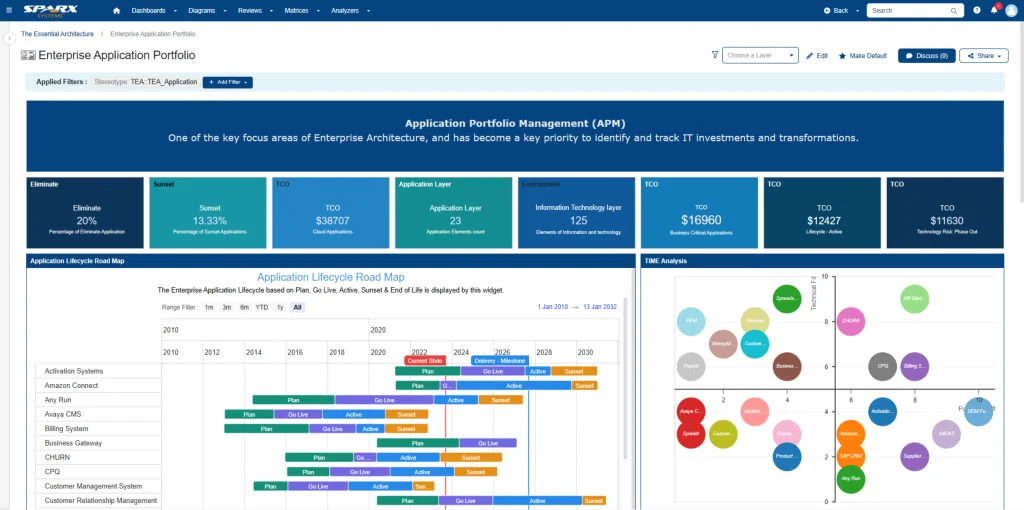
Application portfolio management dashboard in Prolaborate showing TIME categories, TCO KPIs, lifecycle roadmap, and application analysis charts
Dynamic documents, APM dashboards in Prolaborate, and rich pictures were all driven from the same underlying model. Stakeholders could:
- Access mission thread documentation and system views directly through Prolaborate.
- Drill into application and integration diagrams to see what was hosted where and what capabilities were available.
- Trust that what they were seeing reflected the current model, not last month’s slide deck.
For the architecture team, this changed the nature of the work. Rather than constantly re‑packaging information into new documents for each meeting, they focused on curating and improving the model and its generated views. When stakeholders spotted gaps or raised questions, those were fed back as model changes, which immediately flowed through to the dynamic documents and dashboards.
Strengthening mission coherency
This approach significantly strengthened what the team came to think of as mission coherency. By:
- Consolidating information from documents, spreadsheets and PowerPoints into a governed, standards‑aligned model.
- Using a custom MDG and rich pictures to make that model understandable to non‑technical stakeholders.
- Exposing role‑appropriate, browser‑based views through an on‑premises Prolaborate deployment.
…the organization created a single, living view of its missions and systems.
Our Experts can help jumpstart your APM with well-defined decision-grade metrics, aligned governance and role-based dashboards.
Architects could still work with formal notations and frameworks. Commanders and non‑technical officers could work with icons, diagrams and documents that looked familiar. And because everything was driven from the same repository, conversations about missions, capabilities and IT systems were grounded in a shared, up‑to‑date picture.
In a defense context where decisions have real operational consequences, that shared picture is what mission coherency is all about. Organizations that want to replicate this approach can start by implementing APM with Sparx Enterprise Architect and Prolaborate to establish the same governed, model-driven foundation.


