
Managing an application portfolio is a significant undertaking. Organizations often deal with hundreds of systems, each with its own metadata, owners, and lifecycle. Without a central playbook, the environment can become chaotic, making it nearly impossible to know what a specific field actually means or who is responsible for keeping it current. This is where a solid APM data model, starting with a field data dictionary, is essential.
It is more than just a spreadsheet. As leading research data teams explain, it is the rule book that defines and describes the elements of a dataset, laying out variable names, human-readable names, and allowed values. In the context of APM, this means achieving consensus on what “Application Name,” “Criticality,” or “Cost” truly means. When everyone speaks the same language, our reports are accurate, governance is effective, and APM tools like Sparx Systems Enterprise Architect and Prolaborate can properly automate reporting and traceability.
This guide provides a clear framework to build that data dictionary, covering the essential APM fields, data owners, the required refresh cadence, and concepts like data lineage and the golden source.
Hands-on training covering model setup, portfolio attributes, and dashboard configuration for Application Portfolio Management (APM) use cases.
Why an APM Data Dictionary Matters
The APM data dictionary serves as the formal agreement between your business and technology teams. It is the document that specifies what every attribute means and the standards everyone agrees to follow.

The importance of this is clear: when managing hundreds of applications, vague fields or inconsistent names erode trust in reporting. This affects effective decision-making. For instance, if the finance team tracks “retirement date” as the day an app is planned to sunset, but IT tracks it as the last day anyone actually used it, any analysis of technical debt will be fundamentally flawed.
Beyond clarity, a well-governed data dictionary enforces accountability. Every field is assigned an owner, an update schedule, and a “golden source.” Data stewards know exactly what they need to update and when. This structure is precisely what prevents “zombie apps” (those with no clear owner) from accumulating and ensures business sponsors are making smart investment or rationalization calls based on real data.
Key APM Fields & Definitions

An effective APM data model relies on several categories of APM fields. The following categories are essential:
Identity fields
The basics. This includes the app’s unique ID (use a globally unique ID, not just a name, to prevent duplicates), its common name, and any aliases it might have.
Descriptive fields
This defines the application’s function. It includes its business purpose, a clear description, and its functional domain (like “Finance” or “HR”). A best practice is to use a controlled list, or “controlled vocabulary,” for domains so everyone logs them consistently.
Classification fields
How important is this app? Here you will track its criticality tier, hosting type (on-prem, SaaS, etc.), security rating, and data sensitivity. For criticality, you could adapt established risk-level models: Level 1 is low risk, while a Level 5 failure would be catastrophic. Hosting type distinguishes between models, which can be broken down as: IaaS is raw computing, PaaS is a dev environment, SaaS is ready-to-use software.
Lifecycle fields
Where is this app in its lifespan? Track its current state (e.g., “Proposed,” “Active,” “Under Review,” “Sunset”) and its planned retirement date. This is your main feed for modernization planning.
Financial fields
What does it cost? Log the annual cost to operate, any licensing fees, and how those costs are allocated. This is essential for calculating Total Cost of Ownership (TCO) and ROI.
Governance fields
Who is in charge? List the Business Sponsor, Technical Owner, Data Steward, and Security Lead. Industry guidelines suggest that assigning these roles by name is non-negotiable for accountability.
Finally, it is critical to specify units and allowed values for each field (as data management best practices suggest). A drop down list is always preferable to a free-text field. Keep the definitions in your dictionary concise and to the point to avoid any confusion.
Data Ownership & Stewardship Roles
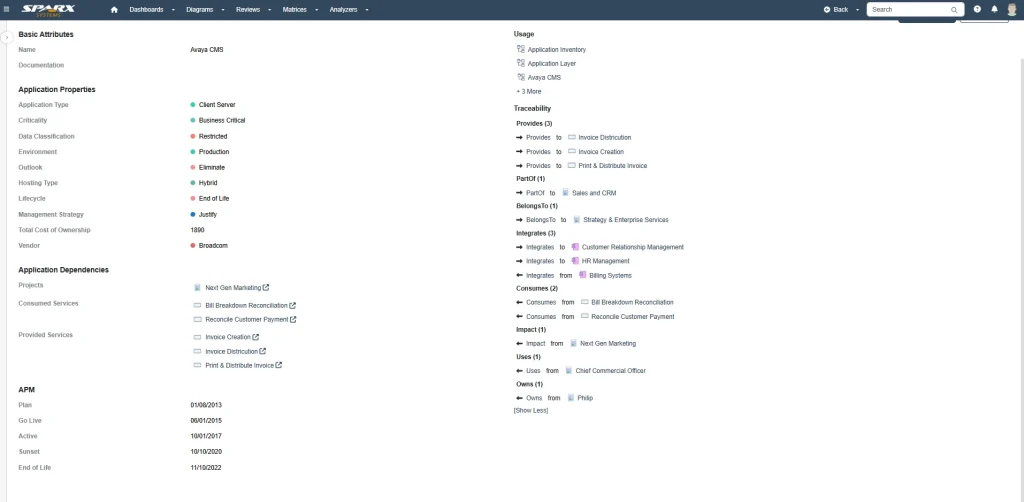
A data dictionary’s value is lost if its data becomes stale, which is inevitable if no one is in charge of it. Clearly defined data owners and stewards are the solution. This is why defining ownership is just as critical as defining the field itself.
The RACI model (Responsible, Accountable, Consulted, Informed) is a straightforward framework for this. In short, it’s a responsibility assignment matrix. Here’s how you would apply it to the dictionary:
Responsible (R)
The individual who performs the work i.e., the Data Steward who physically updates the field. A portfolio analyst might be Responsible for updating cost data every quarter. You can have multiple ‘R’s, but they must coordinate.
Accountable (A)
This is the primary data owner: the individual who is answerable for the data’s correctness, typically the Application Owner or Business Sponsor. There should only be one ‘A’ per field. This is a critical rule for maintaining clear accountability.
Consulted (C)
The subject matter experts you get input from. This includes security leads for classification fields or the finance team for cost estimates.
Informed (I)
People who need to be kept informed but do not edit the data. This is usually enterprise architects or risk managers.
Industry experts offer a stark warning about this: failing to assign primary data owners is how you get “zombie applications.” To prevent this, every app and every field need a named owner. Document their responsibilities, escalation paths, and handover procedures. When an individual transitions out of a role, the first step must be to update the dictionary and notify downstream systems (like Prolaborate or Pro Cloud Server) about the change.
Refresh Cadence & Governance
A dictionary is not a “set it and forget it” document; it is a living asset. As data management experts rightly point out, it must be maintained throughout the project’s lifecycle. For APM, this means every field needs a clear refresh cadence:

- Static fields – Items like the unique ID or the app’s initial description. These rarely change, but it is prudent to review them annually to ensure they are still relevant.
- Periodic fields – This is your cost and usage data. This data should be updated quarterly or semi-annually, ideally aligning this with budgeting cycles so that cost-trend reports are based on current data.
- Event-driven fields – These fields (like “Lifecycle State” or “Owner”) must be updated when a specific event occurs, such as an app moving to production or an owner changing.
- Real-time fields – For performance indicators, you might integrate an automated feed from monitoring tools. Refreshing these daily or weekly depends on what the business actually needs to see.
You also need a simple change management process as part of your overall governance strategy. When a definition changes, the owner needs to log the date, the rationale, and the likely impact. This is where tools like Sparx Systems’ Prolaborate demonstrate their value, as they can handle versioning and audit trails. That audit trail is what stops people from creating conflicting definitions and protects your “single version of truth”—the golden source.
Data Lineage & Golden Source
Once fields and ownership are defined, the final component is establishing data trust. Where did this data come from, and is it the right data? This involves two concepts: data lineage and the golden source.
Data lineage is precisely what its name implies: a map of the data’s journey. It is often described as a documentation and visualization of data’s journey—from its origin, through any transformations, to where it is consumed. For Application Portfolio Management (APM), that lineage might include:
- The origin system (e.g., pulling employee counts from the main HR database).
- Any transformation (e.g., the logic that calculates “annual cost” from 12 monthly invoices).
- The final destination (e.g., a dashboard in Prolaborate or a report in Enterprise Architect).
The value of this practice is clear: good lineage enables rapid troubleshooting. If a report looks wrong, you can trace it back and see if an upstream change caused the issue.
This brings us to the golden source. This concept dictates that all users must pull from the same, authoritative source. You designate one system (like your CMDB or a dedicated portfolio registry) as the official source for each field. All other tools, including Prolaborate, must reference that source, not keep their own copies. This is how you get that single, well-defined version of all the data entities—the “golden record.” When data is updated in the golden source, it should send out a notification so all other tools know to refresh their view.
Our Experts can help jumpstart your APM with well-defined decision-grade metrics, aligned governance and role-based dashboards.
In conclusion, a high-quality APM data model, built on a clear field data dictionary, is the foundation for making intelligent, reliable decisions about your application portfolio. It is more than a technical exercise.
When an organization gets everyone to agree on clear definitions, assign clear RACI roles (with clear data owners), and set up a regular refresh cadence, it builds a shared language. This ensures that everyone, from business sponsors down to architects, is working from the same playbook.
As we have seen, this is not just a local idea, it is backed by established data management principles like data lineage and the concept of a golden source. This discipline is what powers modern tools like Sparx Systems Enterprise Architect and Prolaborate, turning them from simple diagramming tools into a true system for portfolio analysis, application rationalization, and strategic planning.


