
Why Impact Analysis Fails Without Real Traceability
Most impact analysis conversations still start in the wrong place: someone opens a spreadsheet, pings the “one person who knows that system,” and then multiple emails and calls follow to work out who owns what.
When your application landscape is large and messy, three things usually go wrong:
- Traceability lives in people’s heads, not in a shared model.
- Spreadsheets and slide decks drift out of date as soon as projects go live.
- Impact analysis becomes slow, political, and risky, especially for incidents, regulatory change, and decommissioning.
Sparx Systems Enterprise Architect (EA) and Prolaborate change that dynamic by turning traceability into data you can see, navigate, and govern. With the Sparx APM Accelerator and Sparx EA’s metamodel, you pre-configure links across capabilities, processes, applications, data, and technology, then surface them as clickable Prolaborate views for business, IT, and risk stakeholders.
The result: when someone asks “If we touch this system, what else breaks?”, you’re looking at a live model and dashboards, not guesses.
Stop guessing and start deciding. Let our experts help you align your architecture with business goals using proven governance frameworks and clear metrics.
What Do We Mean by End-to-End Traceability with Sparx EA?
In an Application Portfolio Management (APM) context, “end-to-end” means you can follow a thread from a business outcome all the way down to the technology that delivers it:
- Business layer – capabilities and high-level requirements
- Process / service layer – business processes, journeys, and business / application services
- Application layer – application components, integration services, APIs, and interfaces
- Data layer – key data entities, reports, dashboards, and classifications
- Technology / infrastructure layer – platforms, hosting models, networks, OT / IoT, and SCADA where relevant
With this in place, you can answer questions like:
- “If I retire this integration hub, which downstream reports and teams are impacted?”
- “If the regulator changes reporting rules, which data feeds and systems need to be touched?”
- “If this zone in the network is offline, which services and SLAs are at risk?”
The Sparx APM Accelerator uses a deliberately simple but focused meta-model for applications and “everything around them” (domains, services, stakeholders, projects, technology, cost, lifecycle). That keeps traceability manageable in the first iteration instead of trying to model the entire enterprise up front.
How Sparx EA and Prolaborate Enable Practical Impact Analysis
Sparx EA: A Metamodel That Bakes Traceability In
In Sparx EA, traceability is part of the modeling fabric.
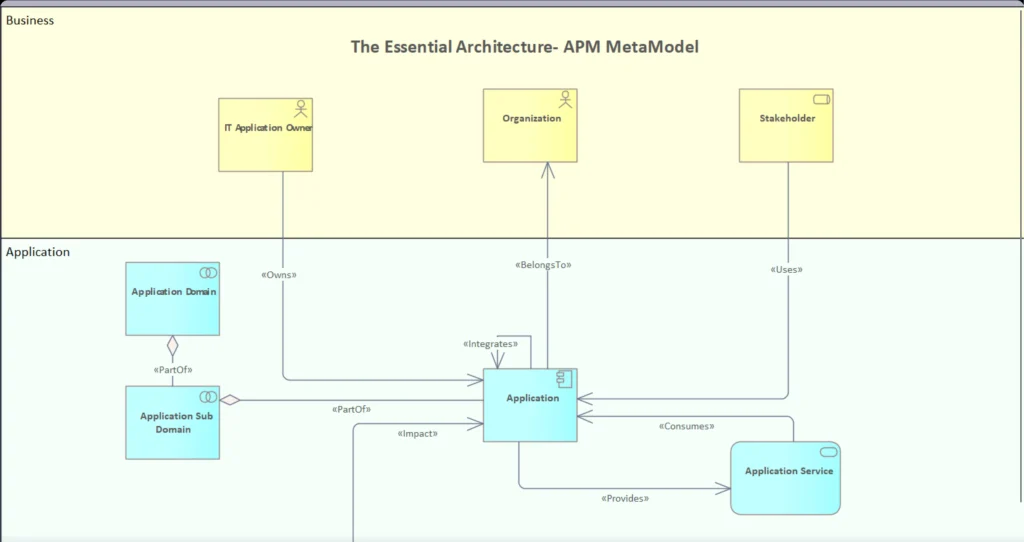
Essential application portfolio management meta-model linking business roles to applications, domains, sub-domains and services.
Using Sparx EA and the APM Accelerator you can:
- Define a meta-model that connects capabilities ↔ processes ↔ applications ↔ data ↔ technology.
- Extend standard notations (e.g., ArchiMate) with business-friendly stereotypes and tagged values such as lifecycle, TCO, criticality, hosting type, and TIME category (Tolerate / Invest / Migrate / Eliminate).
- Import application and asset data from Excel or tools like ServiceNow so you’re not rebuilding everything by hand.
Because the trace links are real connectors in the model, Enterprise Architect can drive diagrams, relationship matrices, and queries that support different impact scenarios:
- Change requests – follow a requirement or capability to all applications, data feeds, and infrastructure that implement it.
- Incidents and outages – start from a failed component and trace up to services, capabilities, and regulatory obligations.
- Regulatory changes – start from a report or KPI and trace back to data sources, applications, and integration points.
- Decommissioning – simulate the removal of an application and highlight dependent interfaces, reports, and capabilities.
Prolaborate: Impact Paths and Dashboards for Non-Modelers
Sparx EA is where the model lives; Prolaborate is how everyone else sees and works with it.
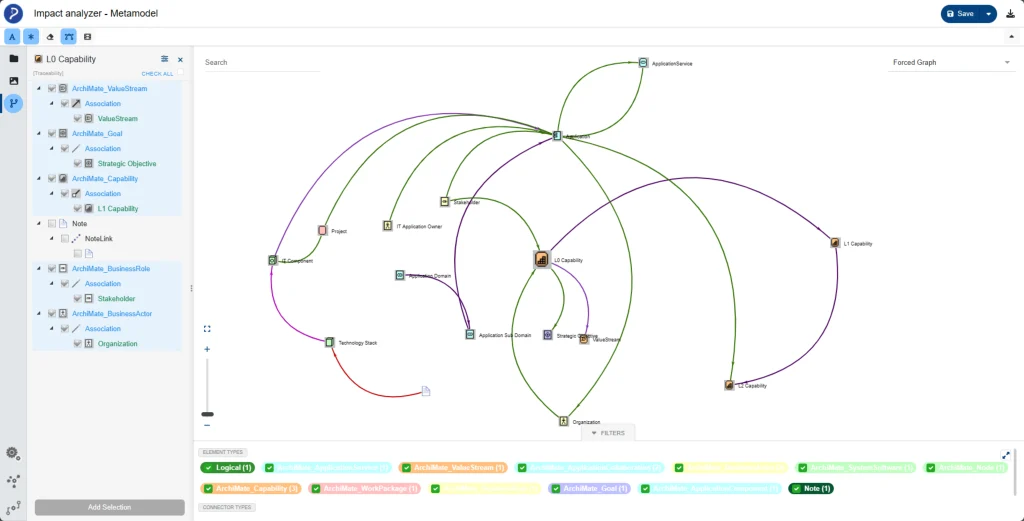
Interactive impact analyzer in Sparx Prolaborate displaying metamodel-level dependencies across capabilities, projects, application domains and application services.
Sparx Systems Prolaborate lets you:
- Publish role-specific APM dashboards (CIO, application owners, operations, PMO) on the same EA repository.
- Present visual impact paths where a user clicks an application or capability and sees related processes, data, infrastructure, and projects in the browser.
- Provide dynamic charts and landscapes (e.g., application roadmaps, TIME quadrants, capability-to-app heatmaps) that update automatically as the model changes.
- Enforce granular permissions, so application owners can maintain lifecycle and cost fields without changing architecture relationships.
A large US healthcare agency, for example, used Sparx EA as an integrated repository and Prolaborate dashboards to support capital planning and governance decisions, fed by a system census and multiple data sources via APIs. The same pattern of a central model plus dashboards is exactly what you need for traceability-driven impact analysis.
Real-World Traceability Examples Across Industries
Global SaaS Provider – Decommissioning a Legacy Integration Hub
A rapidly growing SaaS provider wanted to retire a central integration hub and move to modern integration patterns. Years of ad‑hoc interfaces meant nobody could say who all the consumers were.

Application integration matrix in Sparx Prolaborate showing source-to-target system connections and interface dependencies.
Using Sparx EA and Prolaborate they:
- Modeled the hub and its spokes
Each interface and its downstream BI reports and batch jobs were captured as connectors in EA with tagged values for data domain, criticality, and consumers. - Built an “Integration Risk” dashboard in Prolaborate
Views grouped interfaces by business domain and criticality and highlighted high‑risk consumers such as regulatory reports and month‑end processes. - Planned a staged migration
For each interface, they could see which capabilities and services would be affected by a change and which replacement pattern (API, event stream, direct integration) was planned. A roadmap view showed when each application would switch off the hub.
Because the trace links were already in the model, each migration wave became a repeatable impact analysis exercise, not a fresh round of discovery.
Water Utility – Traceability Across Assets, SCADA, and Business Services
A newly formed water utility in the Middle East was building a greenfield network in a remote region: plants, reservoirs, pumps, valves, pressure zones, and trunk mains. At the same time, it had to integrate OT and IT systems and prove to regulators that service levels and water quality were under control.
In Sparx Systems Enterprise Architect they:
- Modeled the physical asset hierarchy (zones → plants → reservoirs → pumps / valves).
- Linked those assets to SCADA and telemetry points, alarms, and control systems.
- Connected OT systems to IT applications such as billing, customer portals, GIS, and work management.
- Linked applications to reports and dashboards used for regulatory reporting and operational KPIs.

Application integration diagram showing dependencies between core systems in Sparx Systems Enterprise Architect.
The critical traceability chain became:
Physical asset → SCADA tag → OT system → IT applications → dashboards / reports → regulatory & customer outcomes
For a planned change to a pumping station or a problematic pressure zone, operations staff and architects could open a Prolaborate view and see:
- Which assets and SCADA tags were in scope
- Which applications and integrations consumed those signals
- Which reports and KPIs would be affected
- Which business services and SLAs might degrade if something went wrong
Instead of producing static slide decks, they walked stakeholders through live dashboards that reflected the current model, making risk discussions faster and less subjective.
Get a guided walkthrough of Enterprise Architect + Prolaborate dashboards, and visualization use cases tailored to your application portfolio and priorities.
Designing Traceability That Teams Will Actually Maintain
The hardest part of traceability isn’t the toolset, it’s getting people to keep the links current. A simple, focused design helps:
- Start small and stay relevant
Begin with the links that matter most for change and impact analysis: capability–application, application–data, and application–technology. - Make updates part of normal work
Use Sparx EA MDGs / profiles so every application has a small, consistent set of fields (lifecycle, criticality, hosting type, cost) and keep relationship rules simple so people can only create valid connections. - Give value back through views and automation
Let updates show up immediately in dashboards, roadmaps, and TIME views that app owners, PMs, and operations teams actually use, and automate imports and diagram generation wherever possible.


