
Application Portfolio Management (APM) often struggles to be more than a simple inventory with a list of apps that’s hard to link to real business goals. The key to elevating APM from a catalog to a decision-making engine is grounding it in APM and enterprise architecture standards.
This approach connects your portfolio to the entire business, from architecture layers to governance rules. This article is a practical guide to how TOGAF APM, the Zachman framework, COBIT governance, and ISO 20000/27001 ties work together to help you make clearer, better decisions for rationalization, modernization, and business alignment.
Kickstart Your APM with Ready-to-Use Dashboards & Models. Cut Months of Setup into Days—Start with Proven Sparx APM Templates.
What each standard brings to Application Portfolio Management (APM)

So, why bother with standards and frameworks for APM? It comes down to three practical benefits: consistency, traceability, and comparability. You get everyone speaking the same language. You can trace a decision all the way back to a policy. You can compare “apples to apples” when evaluating your investment options.
Each standard has a different job. None of them do it all. Let’s look at the specific role each one plays.
TOGAF APM — structure for strategy‑to‑execution
TOGAF ADM is all about connecting your strategy to your technology. Its main job is to make sure what you’re building (or buying) actually supports what the business is trying to do.
How it helps APM:
- Maps business capabilities directly to your applications, so you can see what’s supporting key objectives.
- Makes reuse a measurable goal, not just a buzzword, using Architecture and Solution Building Blocks (ABBs/SBBs).
- Gives you a formal process for rationalization and for building a governed migration plan to get from your current state to your target state.
Zachman framework — precision of architecture layers
The Zachman framework is a powerful way to organize everything. Think of it as a master blueprint for all your architecture layers, ensuring you’ve covered all the angles (the ‘what’, ‘how’, ‘where’, ‘who’, ‘when’, and ‘why’).
How it helps APM:
- Creates a clean separation of concerns. This stops you from making decisions about technology in a business vacuum.
- Shows you all the relationships between layers, so you can see the full impact of a change.
- Acts as a completeness check. You can quickly spot gaps where you’re missing key information, like what processes or data an app touches.
COBIT governance — controls and accountability
COBIT governance handles the rules, controls, and accountability. It’s the framework that answers, “Who gets to make this decision?” and “How do we know we’re not taking on too much risk?”
How it helps APM:
- Defines your decision rights, formal approval workflows, and policies for risk acceptance.
- Establishes the process controls you need for tricky areas like investment prioritization and third-party risk.
- Provides the metrics and assurance to confirm that your APM efforts (like rationalization) are actually delivering the value you promised.
ISO 20000/27001 ties — service quality and security by design
The ISO 20000/27001 ties bring in operational reality. They connect your portfolio to the day-to-day world of IT service management (ISO 20000) and critical information security (ISO 20001).
How it helps APM:
- Helps you build a service-oriented portfolio, linking apps to the specific business services they support, their SLAs, and operational trends.
- Provides a structured, defensible way to manage security, linking apps to specific risks, controls, and remediation plans.
- Delivers audit-ready traceability. When an auditor asks, you can show the direct line from a risk to its control.
Bottom line: To wrap this part up: TOGAF gives you the process for change, Zachman provides the blueprint, COBIT adds the governance, and ISO bolts on the service and security rules. Together, they turn APM from a simple inventory into a real management discipline.
Practical mappings: APM lifecycle × standard artifacts

You can map these standards directly to the work your team is already doing. Here’s how they provide clear value at each phase of the lifecycle:
Discover & Classify
As you inventory your apps, Zachman provides the structure to organize by architecture layer. ISO 27001 informs what app portfolio data to capture (classification, owners), and COBIT clarifies who is accountable for the inventory’s accuracy.
Assess & Score
TOGAF APM gives you the criteria (target-state fit, reuse potential) to score your apps. COBIT adds the risk and control maturity scores, while ISO 20000/27001 provide real-world context like service impact and security posture.
Rationalize & Decide
This is where TOGAF offers decision patterns (reuse vs. buy) and COBIT provides the auditable approval gates. Zachman plays a key role by ensuring you see the full impact of a decision on all business and data layers.
Plan & Deliver
TOGAF guides the migration roadmap. COBIT inserts critical control checkpoints (like vendor risk management), and ISO 20000 informs the service transition plans and rollback criteria to protect operations.
Operate & Improve
Finally, COBIT/ISO provide the framework for monitoring metrics and audit trails. TOGAF loops back to measure benefit realization—did you actually achieve the goals you set?
Making standards consumable for stakeholders (views, not jargon)
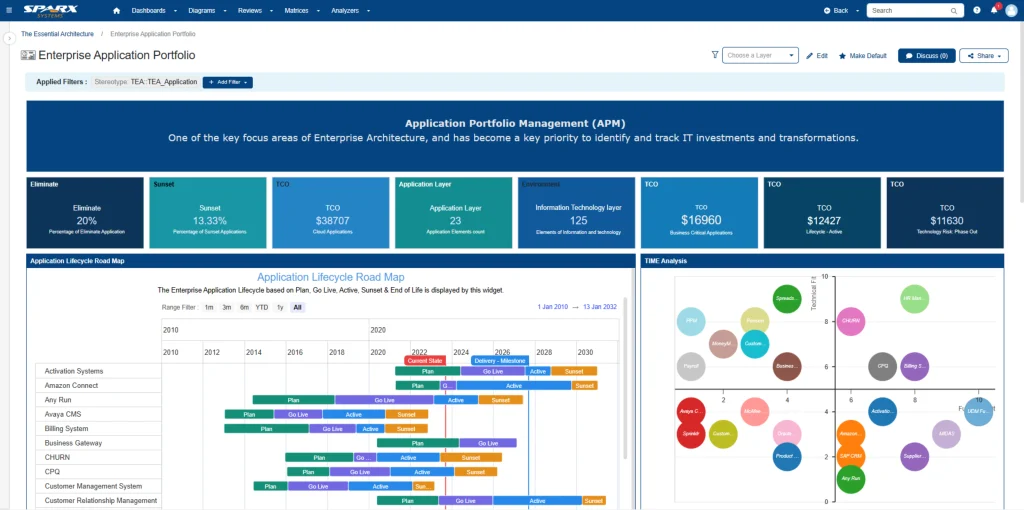
Having a solid model is critical, but it’s also equally important that you communicate APM insights clearly to the stakeholders. The final, and most important, step is translating this data for your stakeholders.
Start with the audience, not the framework
This is the key. Always tailor the information. Forget the jargon.
- Executives don’t want framework jargon. They want to know about value, risk, and timing. Show them capability coverage, investment requests, and milestone impacts.
- Product and service owners want to know about change readiness. Show them service windows, dependencies, and rollback criteria.
- Security and compliance teams need control evidence. Give them simple, clear views of mapped controls, test status, and exceptions.
- Engineering and data teams want the specifics. Show them the interfaces, data contracts, and end-of-support risks.
Practical view patterns that work
Resist the urge to export a giant, auto-generated report. Use simple, story-telling visual patterns instead:
- One-Page Portfolio Overview: A KPI-backed summary of value, cost, and risk. Include a “top moves this quarter” (retire, modernize, etc.).
- Decision Storyboard: A simple flow: here’s the problem, here were the options, here’s our recommendation, and here’s the residual risk.
- Wave Plan with Guardrails: A visual roadmap showing what apps are in each wave, their dependencies, and the controls they must pass.
- Risk & Control Dashboard: A heatmap that maps applications to control objectives to highlight gaps before an audit.
Language tips to keep standards human
This is the most important part: speaking like a human.
- Translate terms: “Artifact” or “building block” becomes a “documented decision” or a “checklist.”
- Show, don’t tell: A color-coded map is almost always better than a long paragraph.
- Tie back to outcomes: Every single view you create should answer the question, “What changes and why now?”
Embedding in day‑to‑day rhythms
This can’t be a once-a-year project. To make it stick, you have to embed these views into your team’s normal routines.
- Use the standard-aligned scorecards in your quarterly portfolio review.
- Change advisory: add control checkpoints to change templates.
- In service reviews, trend incidents and SLA breaches against rationalization progress.
When standards become regular routines, APM stops being a documentation exercise and starts shaping business outcomes.
Secure, Scalable Architecture in the Cloud or On-Prem
Standards turn APM into a repeatable, auditable engine for change
When you get right down to it, APM is most effective when it’s anchored in APM and enterprise architecture standards. They aren’t just for compliance; they’re a complete system for making better decisions.
TOGAF APM provides the roadmap. The Zachman framework draws the blueprint, so you don’t miss anything. COBIT governance adds the guardrails and accountability. And ISO 20000/27001 ties connect it all to your live, operational reality of service and security.
When you put these pieces together, you get a unified language for talking about value, risk, and feasibility. You can move faster, de-risk your modernization plans, and finally keep your application portfolio locked in on what the business actually needs.


