
Mergers and acquisitions (M&A) are complex events. While they promise new opportunities, they often create significant IT challenges. The newly formed organization can find itself managing extensive app duplication, with unclear lines of ownership and rapidly increasing costs. This is where realizing the benefits of application portfolio management becomes essential.
APM provides a structured approach to this merger rationalization. It helps leaders spot redundant systems, decide on a portfolio consolidation strategy, plan out divestitures (carve-outs), and ensure the entire integration roadmap actually lines up with the company’s strategic goals.
Cut Months of Setup into Days—Start with Proven Sparx APM Templates
Pre Close Due Diligence: Data You Need
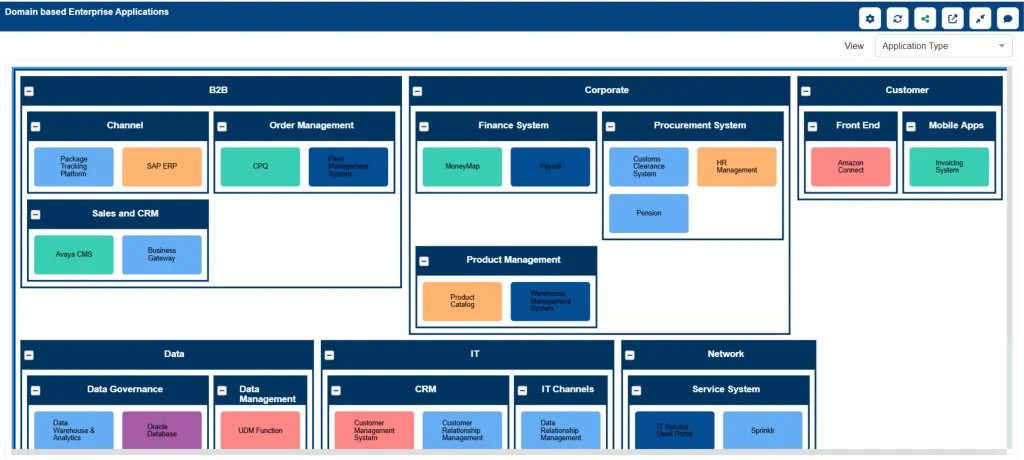
Before the deal is finalized, both IT and business leaders need a clear, objective assessment of the combined technology landscape. This isn’t just a technical exercise; it’s about understanding potential costs and risks. You should focus on four key areas:
Application Inventory
The first step is to identify what software everyone actually uses. You need a complete list from both companies. For each app, find out who owns it, what it costs (including all licensing), what business purpose it serves, and what technology it runs on. A simple spreadsheet is a good starting point for an APM initiative, which you can later import into a tool like Enterprise Architect to build a more formal model for your redundancy analysis.
Contractual Obligations
You must understand what contracts you are inheriting. Review all vendor agreements and subscription terms. Pay close attention to renewal dates and termination clauses. This information is critical for understanding future liabilities and for negotiating any Transition Service Agreements (TSAs).
Technical Health & Risk
It is critical to determine how much of the new portfolio is obsolete or insecure. You need to identify all hidden technical debt. Document end-of-life dates for software, assess the overall security-readiness, and note any known vulnerabilities. This level of portfolio visibility is key to risk reduction and helps you estimate the real effort required for cleanup and migration before they become your organization’s responsibility.
Data Residency & Compliance
Understanding where data is physically located is a critical concern. You must document where customer and corporate data resides and identify all regulatory rules (like GDPR or HIPAA) that apply. This will directly impact how or even if you can migrate or integrate certain systems.
The Payoff: This preparatory work provides a realistic budget, a workable timeline, and a much clearer understanding of whether those promised “synergies” are actually achievable.
Overlap Identification via Capability & Process Mapping

Once the deal is closed, the integration work begins. Your first APM-driven task is to conduct a thorough redundancy analysis to identify exactly where the application overlap is and what’s missing.
Steps
- First, map out the core business capabilities for both of the original organizations (e.g., “Manage Customer Orders,” “Process Payroll”).
- Next, overlay the applications that support each of those capabilities. This will immediately show you where you have duplication (e.g., two CRMs for one “Sales” capability) and where you might have gaps.
- Finally, map the most important business processes and how data flows between these systems. You need to understand these connections before you can safely unplug anything.
What you’ll uncover
This process quickly reveals the most important issues. You’ll find:
- Obvious App Duplication: These are the most straightforward opportunities. For example, you now have two separate CRM platforms and two HR systems. This portfolio consolidation is a clear path to cutting licensing and support costs.
- Complementary Strengths: You might find that one company’s system is vastly superior to the other’s. This gives you an easy win: retire the weaker application and move everyone to the stronger platform.
- Critical Gaps: You may also discover that even with the combined portfolios, key business functions are still unsupported. This helps you prioritize new investments.
Consolidation Scenarios with Cost, Risk & Complexity Scoring
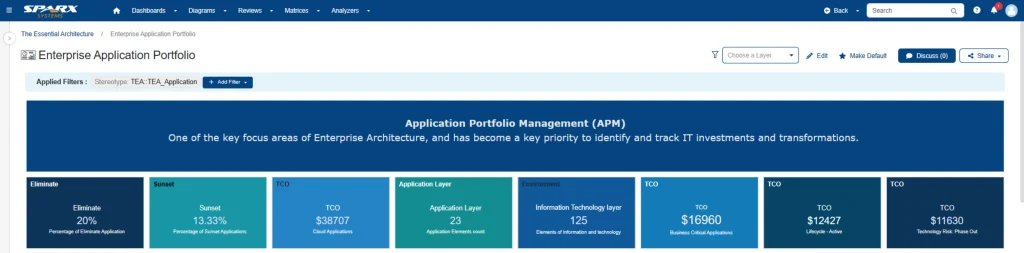
Now that you have identified all the redundant applications, you must evaluate your portfolio consolidation choices. For each area of overlap, there are typically three main options:
Typical options
- Retain & integrate: You might decide to keep both systems. This sometimes makes sense if they serve completely different regions or business units, but only if the cost of integrating them isn’t prohibitive.
- Retire & consolidate: This is the most common choice. You pick the stronger platform, migrate all users and data to it, and shut the other one down.
- Replace & modernize: If both applications are outdated, the merger provides the perfect opportunity to replace both and invest in a modern, new solution.
Score with weighted criteria
To make the best choice, you need to score these options objectively. We recommend using a weighted scorecard based on a few key criteria:
- Cost: What are the real costs for licenses, migration, and retraining?
- Risk: What’s the risk of business disruption? Are there security or compliance issues?
- Complexity: How hard will it be to move the data, recreate customizations, and manage the change for employees? This also informs your future integration architecture.
A tool like Prolaborate is highly beneficial here. You can use visual dashboards for smarter APM to visualize these scenarios (such as cost/risk bubble charts) and, just as importantly, create a formal record of why a decision was made.
Carve Out Planning & TSA Reduction Strategies
APM is not just for acquisitions; it is also critical for divestitures. A divestiture (or carve-out) requires you to precisely separate a part of the business without disrupting ongoing operations. A solid APM plan is the key to executing this separation efficiently and exiting costly Transition Service Agreements (TSAs) faster.
Key activities
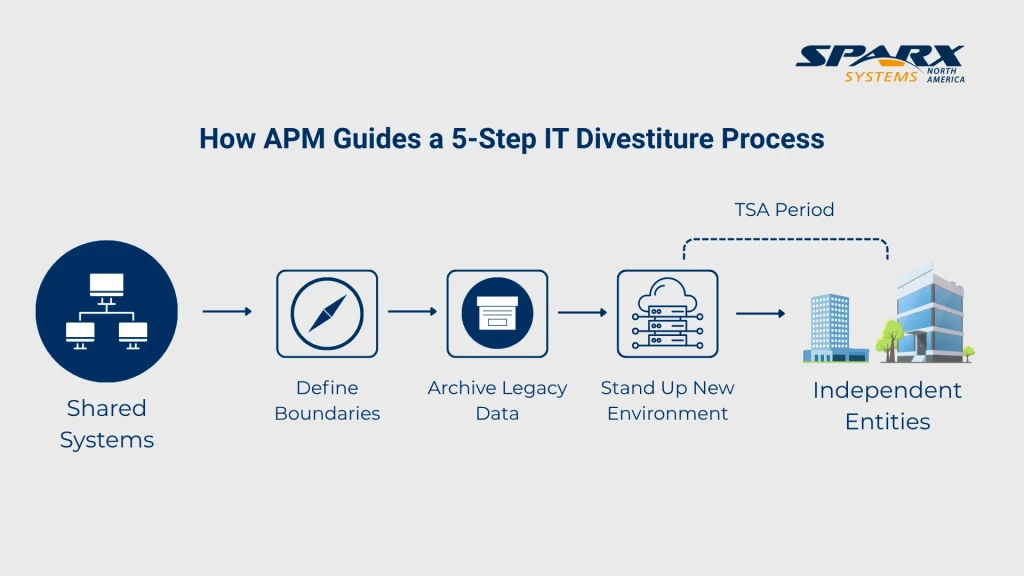
- Define the Boundaries: You must clearly define what goes and what stays. Which applications, which data, and what dependencies (like APIs) need to be replicated for the new, separate entity?
- Archive Legacy Data: Move historical data from the live systems to a secure, compliant archive so you can shut down the original applications.
- Stand up the New Environment: This involves provisioning new infrastructure or new SaaS accounts and then planning the cutover, often in carefully managed waves.
- Minimize TSA Duration: The goal is to make the “new” company independent as fast as possible. The sooner you accelerate their migration and decommission the old systems, the sooner you stop paying for the TSA.
Tip: Use roadmap views to visually stage the migration and decommissioning dates. You can track readiness checklists and manage go/no-go decisions directly in Prolaborate reviews.
Tools & Dashboards for M&A Integration (Sparx Systems)
The Sparx Systems Architecture Platform is designed to support this entire journey:
- Enterprise Architect: This is where you model the combined inventory, map all the dependencies, and design your integration architecture. It’s your single source of truth for merger rationalization.
- Pro Cloud Server: This enables teams from both of the original companies to collaborate securely in one place.
- Prolaborate: This serves as your communication layer. It lets you publish role-specific dashboards and conduct formal reviews for everyone involved.
Dashboards include:
- Traceability matrices (showing capability-to-application redundancy)
- Scenario Analysis Reports (with your cost, risk, and complexity scores)
- Milestone roadmaps (for integration and decommissioning timelines)
- Audit trails (to capture every discussion, decision, and approval)
Get Measurable APM Results in Weeks, Not Months
Ultimately, the real value of a merger is not realized until the complex integration work is complete. Success means you have simplified the application portfolio, cut unnecessary costs, and reduced your risks. It means everyone is finally aligned on a single roadmap.
Having a structured approach to M&A application portfolio management, supported by good due diligence data and objective scoring is what transforms a complex integration into a manageable, repeatable process. Using Enterprise Architect, Pro Cloud Server, and Prolaborate provides the data-driven foundation you need to make informed decisions, exit expensive TSAs, and deliver on the merger’s original promise.


