
Cloud migrations often become complex and disorganized. When decisions are based on scattered opinions rather than facts, the process can be delayed by disagreements about what to move first. Application Portfolio Management (APM) streamlines this process. It provides a structured method to evaluate your applications, weigh your choices, and—most importantly, plan the migration in a logical order to reduce risk. This process, using scorecards, the “6R” framework, and dependency maps, helps transform an overwhelming migration backlog into a clear, step-by-step plan.
What does this look like in practice? It means using your EA dependency model to visualize how a change in one area might negatively impact other systems. It’s about sorting your migration backlog by business value versus the level of effort required. It also involves presenting this plan in roadmaps that different stakeholders can clearly understand.
In this article, we’ll outline the entire APM for cloud migration planning process from the initial assessment to tracking the outcomes. The goal is to give executives a clear view of progress, provide clarity for the teams doing the work, and build a migration process your organization can reuse for future initiatives.
Cut Months of Setup into Days—Start with Proven Sparx Application Portfolio Management Templates
Cloud‑Fit Scoring Made Simple: Functional, Technical & Risk
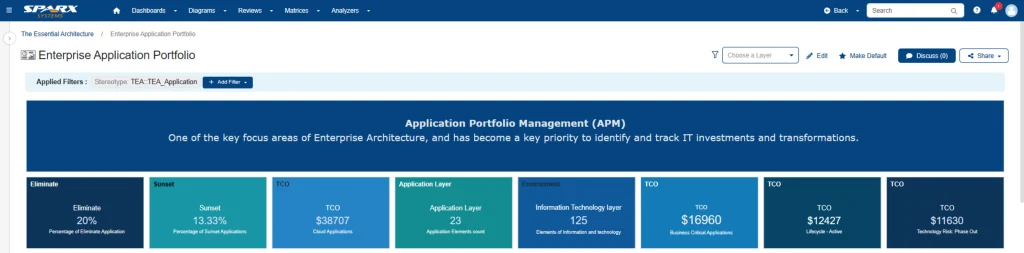
Instead of subjective judgments, a “cloud-fit” scorecard provides a consistent APM assessment framework to make decisions about cloud readiness. The objective isn’t to create a perfect, complex system from the start but to establish a simple baseline that can be refined.
This scoring process should evaluate three key dimensions:
- Functional Fit: its business criticality
- Technical Fit: its architecture and data gravity
- Risk Posture: data sensitivity and regulatory needs
APM is what operationalizes this scoring. It transforms the application catalog into a dynamic tool, linking each app to its supporting evidence (like diagrams, SLAs) and its app cloud fit score. This allows you to see the full context, such as how a high-scoring app might still be a poor first-wave candidate due to its dependencies.
By keeping the criteria simple and making the scoring collaborative, you create a transparent, reliable view of your portfolio. This score becomes the foundation for your migration prioritization, turning a static spreadsheet exercise into a dynamic planning tool.
6R Decisioning Made Easy: Estimate Effort vs. Value

The “6R” framework (Rehost, Replatform, etc.) is a useful model, but it only becomes effective when connected to real-world effort and value. APM provides the data to confidently make these trade-offs.
The key is to map each potential “R” strategy onto a simple two-axis chart of Effort vs. Value. Bubble charts for application rationalization make this clearer by using bubble size to represent a third factor like cost, risk, or user impact.
- High Value / Low Effort: These are your “quick wins” for early waves, typically a Rehost or Replatform.
- High Value / High Effort: These are major transformations, like Rearchitect or Refactor, which the chart confirms are worth planning as staged projects.
- Low Value / Low Effort: These are opportunistic quick wins, or items that can be deferred.
- Low Value / High Effort: These items are clear candidates to Retain or Retire.
APM finalizes this by grounding your effort estimates in real data from the portfolio (like code complexity or known constraints) and ensures decision traceability. This creates a dedicated migration backlog and a defensible plan with clear expectations on cost, benefits, and timelines for executives.
Dependency Analysis: Find Blockers Early and De‑Risk Wave Planning
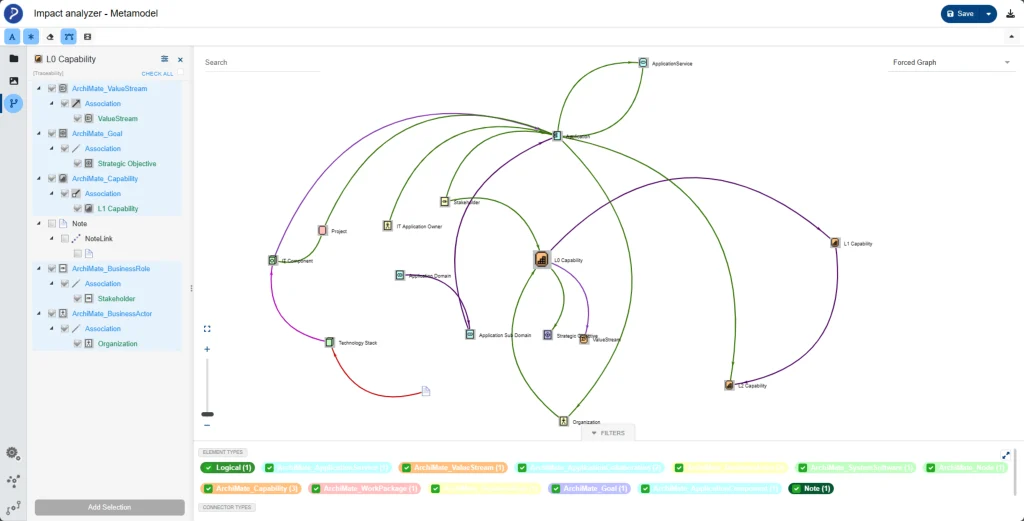
A high cloud-fit score is a good indicator, but a hidden dependency can derail an entire migration. Using APM with a solid EA dependency model clarifies these connections, allowing you to plan the migration sequence safely.
This means modeling the critical connections, including:
- Data lineage: to know where data comes from and where it goes.
- Integration contracts: to understand all APIs, file drops, and message queues.
- Shared platforms: to identify central systems like identity or reporting.
This model allows for “blast radius analysis” to see which systems are impacted if an application moves and helps identify which applications must move together.
In APM, you can tag these dependencies by criticality and even associate temporary “bridges” with expiry dates. By reviewing these dependency maps in an architecture forum before locking in a wave, you ensure fewer unforeseen issues, more accurate runbooks, and a practical plan that respects your real-world system interdependencies.
Migration Waves and Runbooks: Clear Views for Execs & Teams

A good plan is one that everyone can understand. APM helps organize a long migration backlog into logical waves for wave planning, each with clear goals and owners.
These waves are typically:
- Grouped thematically: such as by business domain or shared platform.
- Sized realistically: based on your team’s actual capacity.
- Assigned to target landing zones: ensuring those cloud environments are ready.
This all comes together in the runbooks—step-by-step playbooks for each phase:
- Pre-cutover: all readiness checklists and data sync plans.
- Cutover: the step-by-step tasks and rollback criteria.
- Post-cutover: including smoke tests and ongoing monitoring.
To keep everyone aligned, APM provides different views for different audiences:
- High-level Dashboards: for executives to track progress and budget.
- Detailed Boards: for teams to manage tasks and dependencies.
- Timeline-Based Roadmap Widgets: for stakeholders to see a filtered “what’s next” view.
This combination of clear waves, detailed runbooks, and tailored views reduces confusion and gives the delivery teams the confidence to move forward.
Track Results After Migration: Cost and Performance Deltas
A migration is not complete just because an application is in the cloud. True success is measured by the improvements it delivers. APM helps you track performance after the go-live, creating a feedback loop to learn, optimize, and demonstrate value.
This starts by defining success early, setting baselines for:
- Cost: comparing baseline on-premise costs to new cloud spend.
- Performance and Reliability: tracking latency, throughput, and error rates.
- Operational Efficiency: measuring improvements like deploy frequency and lead time.
After migration, you use APM as the single source of truth, linking monitoring dashboards and incident records back to the application. This allows you to create simple “before-and-after” reports to prove the delta, tracking cost anomalies or performance gains.
Most importantly, this data closes the loop. You can:
- Update an Application’s Cloud-Fit Score: based on its real-world performance.
- Apply Lessons Learned: to improve estimation models for the next wave.
- Flag Apps That Need Rightsizing: if they miss cost or performance targets.
This provides a measurable narrative that directly connects the migration effort to real business value, which is critical for maintaining executive sponsorship.
Fast-Track Your APM Efforts and Maximize ROI with Sparx Systems North America’s Expert Consulting
Ultimately, using APM for cloud migration planning replaces uncertainty with a disciplined, evidence-based program. It creates a common language with a cloud-fit scorecard. It connects your strategy to the actual work using the 6R framework. It reduces risk by clarifying dependencies with an EA dependency model. It keeps teams aligned with clear migration waves. And finally, it demonstrates the value of the work by tracking performance after you go live.
The goal isn’t to create unnecessary documentation. It’s to build a reliable migration process you can reuse. Start small, and refine your scoring and estimation with each wave. Keep your migration backlog prioritized. Use landing zones to ensure consistency, make dependencies visible to everyone, and consistently track clear metrics.
APM Platforms like Sparx Systems Enterprise Architect and Prolaborate provide a specialized toolset to manage the models, data, and roadmaps to execute all of these steps effectively. When you follow these steps, cloud migration stops feeling like a large, high-risk project and becomes a predictable part of how you improve your business. With every wave, your entire application portfolio improves.


