
What is APM in Sparx Enterprise Architect? In simple terms, it’s the shift from a static inventory to application portfolio modeling that connects systems to real business needs. In Enterprise Architect, each application isn’t just a row in a sheet, but an object with owners, costs, risks, lifecycle, and clear links to the capabilities and processes it serves. That context helps leaders spot duplication, aging tech, and blind spots faster. The goal is straightforward: give decision‑makers a shared view so they can rationalize, modernize, and align spend with strategy.
This article outlines the problem of an unmanaged application landscape, define practical APM objectives, and show how Enterprise Architect plus Prolaborate turn portfolio data into actions without heavy tooling or jargon.
Discuss your Application Portfolio Management Context, data sources, and governance goals with SSNA’s expert consultants.
The Problem: Why Unmanaged Application Landscapes Lead to High Costs and Risk
Portfolios go off course when teams add quick‑fix tools to solve today’s problem, keep legacy systems “just in case,” and buy stand‑alone point solutions without coordinating across the organization. This results in overlapping functionality, mounting license costs, and unclear ownership. Integration becomes fragile. Security patches slip. Application dependencies are hard to trace. No single view explains what is critical or what can be retired.
Typical signals that the portfolio needs attention:
- Two or more applications doing the same job in different departments.
- Missing basic metrics like agreed owner, lifecycle stage, or cost center.
- Rising run costs from unused licenses or duplicated maintenance.
- Unknown or undocumented interfaces that turn simple changes into risky deployments.
When the portfolio lacks structure, decisions lean on assumptions. That’s expensive and avoidable. A clear Sparx Enterprise Architect APM model reduces noise and creates a single place to see cost, risk, ownership, and value.
Core APM Objectives: Aligning Business, Cost, and Technology
A practical APM programme does three things well:
- Show business relevance: Map applications to the capabilities and processes they enable so you can see value, not just inventory. This is the core of business capability to application mapping.
- Quantify cost and technical health: Track total cost of ownership, lifecycle status, and risk so investments go where they matter most.
- Create clear actions: Make rationalization decisions to classify each application as tolerate, invest, migrate, or retire and build a time‑boxed plan.
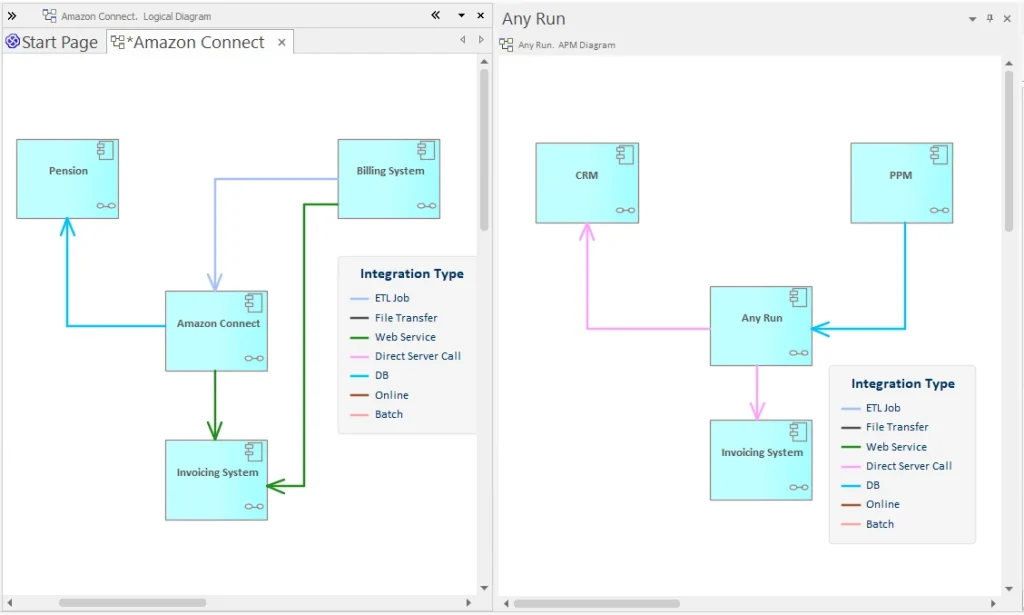
In Enterprise Architect, you capture these basic metrics in the form of metadata such as owner, lifecycle, cost, risk, platform, and link apps to business and technology layers. Views like the Relationship Matrix and Hierarchy make impact obvious (for example, “If we retire X, which processes, integrations, and teams are touched?”). These are practical APM objectives that any team can adopt.

How Sparx EA Models Your Entire Application Portfolio
Enterprise Architect is more than diagramming; it’s a structured repository. You can start building an application inventory in Sparx EA by importing records from spreadsheets or external sources, then model each application as an element with properties such as owner, lifecycle, platform, cost, and risk. Organize by domain and sub‑domain, link to business capabilities, and capture interfaces to show real dependencies.
In practice, teams use EA to:
Organize the Application Landscape
Group applications by domain, apply stereotypes, and model interfaces to make EA application dependencies visible at a glance.
Record Key APM Metrics
Define the right KPIs for APM using tagged values for operating cost, risk, or technical debt; represent lifecycle status directly on diagrams.
Connect Business and IT
Link applications to the capabilities and processes they support to spot redundancy and gaps quickly.
This structure turns scattered data into application portfolio modeling that can be queried, versioned, and reused.
Where Prolaborate Fits: Turning EA Data into APM Dashboards
Sparx EA holds the source of truth; Prolaborate makes it easy to consume. With Pro Cloud Server, authorized users can review models in a browser. Prolaborate then layers on dashboards, heatmaps, and charts tailored to each audience so that executives see cost and risk trends, portfolio owners see lifecycle and usage, and technical teams see integrations and platforms.
These are Prolaborate stakeholder views—role‑based pages that surface exactly what a given group needs. Stakeholders can comment on diagrams, track changes with watch lists, and contribute without opening the desktop tool. Publishing the portfolio this way turns static content into living, shared evidence for decisions.

Typical APM Outcomes with Sparx EA (Cost Reduction, Risk Mitigation)
When organizations model their application estate in EA and share it through Prolaborate, three outcomes show up quickly:
End‑to‑End Traceability
Every application can be traced to its owner, the capabilities it enables, the integrations and data it touches, and the technologies it runs on, so impact and accountability are always clear.
Lower Run Costs
Duplicates and low‑value apps are easier to spot and consolidate, reducing license and support spend.
Reduced Risk
Obsolete tech, unsupported platforms, and brittle integrations become visible, so remediation can be planned and tracked.
Clear Roadmaps
TIME categories (tolerate/invest/migrate/retire) and domain views help prioritize by business criticality, data sensitivity, or hosting model.

These are tangible APM outcomes with Sparx EA, particularly around APM cost and risk. Teams also benefit from traceability during change. When someone proposes retiring an app, impact analysis shows the affected processes, interfaces, and stakeholders before a decision is made.
Equip your team with the skills to build a robust APM framework. Master model repository setup, attribute management, and dashboard configuration.
Keeping a clean inventory is not the goal; better decisions are. Enterprise Architect provides a reliable structure for your portfolio with accurate metadata, relationships, and history, so impact is visible and governance is repeatable. Combined with Prolaborate, that structure turns into role‑specific dashboards and collaborative reviews.
In short, implementing Application Portfolio Management with Sparx Systems EA and Prolaborate lets you model once, reuse often, decide faster. Start with ownership, lifecycle, cost, and risk; connect applications to the capabilities they serve; and publish the results for your stakeholders.
If someone asks “Which applications should we keep, modernize or retire?”, you can point to a living Sparx APM model that shows value, risk, and dependencies, not another spreadsheet.


