
Application portfolio management (APM) is much more than a simple technical exercise. It’s a core business process, guided by established APM frameworks, standards, and best practices, for making smart decisions across both IT and business units.
Without clear roles and defined lifecycle states, your application inventory is just a spreadsheet gathering dust. It’s not a living tool that helps you take action. A good governance model answers the practical, everyday questions. Who can propose a change? Who controls the budget? Who is accountable for retiring an old system?
Using standardized application lifecycle states like Plan, Go Live, Active, and Sunset ensures everyone is speaking the same language. By setting a regular review schedule and tracking your decisions, you create a clear audit trail. This makes every decision traceable and keeps the entire portfolio aligned with your company’s strategy.
Kickstart Your APM with Ready-to-Use Dashboards & Models
Decision Rights: Who Retires, Funds, and Approves
Good governance starts by defining who gets to make the final call at each stage. When you document these decision rights, you assign clear accountability and make sure the right people are reviewing the right proposals.

Key practices
- Define authorization tiers: Not all decisions are equal. A simple version upgrade might only need a domain architect’s approval, while a major application retirement requires review from a full portfolio board or executive committee.
- Establish funding authority: Be clear about where the money comes from. Does the CIO fund a rationalization effort, or does the business unit? Clarifying this ensures any cost savings are tracked and reinvested properly.
- Separate proposal from approval: To avoid conflicts of interest, the person proposing a change (like an application owner) shouldn’t be the same person approving it. Approvals should include stakeholders from finance, risk, and strategy.
- Document rationales: Every decision needs a paper trail. Make sure to capture the “why”—the business case and the criteria you used to make the call.
This is where a clearly defined application ownership model using RACI (Responsible, Accountable, Consulted, Informed) matrix really shines. It cuts through confusion and speeds up the process from a simple recommendation to a fully-executed plan. When people understand the process, it builds trust and keeps everyone focused on the same business goals.
Ownership Model: Roles and Responsibilities

APM governance doesn’t run itself. It relies on a dedicated team of people from across IT, business, and finance. When you assign these responsibilities clearly, you ensure the data is reliable and that people are accountable for the results.
Application Owner
This person is the subject-matter expert for a specific application. They are responsible for keeping all its information such as cost, usage, risk, and technical health up-to-date and accurate. They lead the discussions about its future and work with technical teams to get things done.
Portfolio Lead
This person manages the big-picture view for a specific domain or business unit (e.g., “all Marketing applications”). They are responsible for prioritizing rationalization efforts, building recommendations for the review board, and coordinating work across all the application owners in their area.
Enterprise Architect
The EA is the guardian of the future state. They ensure that decisions align with the company’s technology standards and long-term roadmap. They also help define the scoring models and how APM integrates with other systems.
Finance Partner
This role keeps the numbers honest. They validate cost data, track the actual savings from rationalization, and make sure investments and savings are accounted for correctly. They are crucial for setting realistic budget targets.
Risk & Compliance Officer
This person guides the team on critical security and regulatory requirements. They ensure the entire portfolio stays compliant and that any proposed changes are properly checked for risk.
Review Cadence & Change Control
Governance isn’t a “set it and forget it” task. It only works if it’s a regular, ongoing process. A structured schedule (or “cadence”) keeps the portfolio current and ensures that you revisit your decisions as the business changes.
Recommended Flow
- Quarterly portfolio board meetings: This is the big review. Use this time to look at assessment scores, debate rationalization proposals, and formally approve new investments.
- Monthly data refreshes: Data gets stale fast. Set a monthly deadline for application owners to update their cost, usage, and risk information. Where possible, automate this by pulling data directly from your CMDB, finance systems, or discovery tools.
- Change control processes: Define the exact steps for moving an application from one state to another. For example, moving an app from Active to Constrained might require a new risk assessment, while a Sunset decision kicks off a formal decommission plan and user communication.
- Audit and compliance checks: Regularly check your data for completeness and accuracy. Use these reviews to get feedback and formal sign-offs from stakeholders.
- Continuous feedback loops: After each cycle, ask what worked and what didn’t. Use that feedback to refine your scoring, streamline workflows, and improve the process for next time.
Lifecycle States: Proposed, Active, Constrained, Sunset
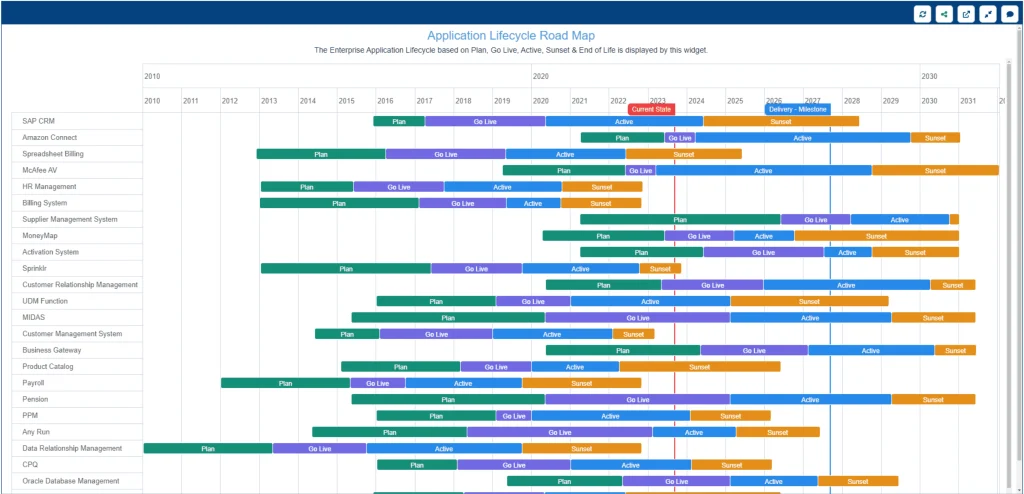
Lifecycle management gives you a clear, high-level view of where every application stands. Using a simple, consistent set of states is the key. It cuts down on confusion and makes reporting much easier.
Proposed
This is a new application or solution that isn’t fully implemented yet. In this stage, you analyze its potential business value, cost, and risk to decide whether to move forward, revise the plan, or reject it.
Active
These are the applications currently in use and fully supported by IT. They are the core of your portfolio and may be getting continuous improvements. However, if an Active app shows high cost or risk, it becomes a prime candidate for rationalization.
Constrained (Tolerate)
This application still serves a valid purpose, but it has issues—it might be high-risk, built on old technology, or cost too much. You limit any new investment in it until a replacement is ready. Keep a close eye on these.
Sunset
This application has been formally approved for retirement. The focus shifts to planning its decommissioning, including data migration, user communication, and managing any final risks. It must be completely removed from service within a set timeframe.
Extension ideas: You can get more granular by adding states like Retire, Replace, or Transform. Visualizing this data in funnel or bar charts is a great way to show your rationalization progress at a glance.
Automating Evidence: Dashboards, Audits, and Discussions

For governance to be effective, you have to be able to show your work. You need solid data and documentation to prove that decisions were made carefully and objectively.
This is where automation becomes a huge help. It cuts down on the administrative busywork and makes the entire process more transparent for everyone.
Practices to implement
- Dashboards & scorecards: Create simple visuals for your key metrics (KPIs). These visual dashboards for smarter application portfolio management can show things like the number of applications in each lifecycle state, total run costs, cumulative risk scores, and the savings you project.
- Audit trails: Use built-in revision histories or logs to capture who changed what, and when. This is non-negotiable for accountability.
- Meeting documentation: Don’t let meeting decisions vanish, use platforms that allow teams to collaborate and formally review APM decisions. Attach agendas, participant lists, and key outcomes directly to the relevant dashboards or models. This creates an invaluable institutional memory.
- Benefits tracking: Don’t just project savings—track them. Create a report that shows the actual cost savings, risk reduction, and business value you’ve achieved compared to your original business case.
Connect Stakeholders with Real-Time Architecture Insights
In the end, successful APM isn’t really about the applications themselves. It’s about the people and the process you build around them.
It’s about establishing a clear, fair, and repeatable structure for making decisions. This clarity is what stops the political infighting and “shadow IT” by defining who can propose a change, who pays for it, and who has the authority to approve it. When you assign clear roles from the Application Owner to the Finance Partner, you create a culture of accountability.
Tools like Sparx Systems Enterprise Architect help you model and connect this complex information, while platforms such as Prolaborate make it accessible to all stakeholders through tailored dashboards and collaborative views, putting these best practices into action. A regular meeting schedule and simple lifecycle states transform your portfolio from a static list into a dynamic tool for change. This is how you build trust and demonstrate the benefits and business value of APM.


