
What is an Enterprise Architecture?
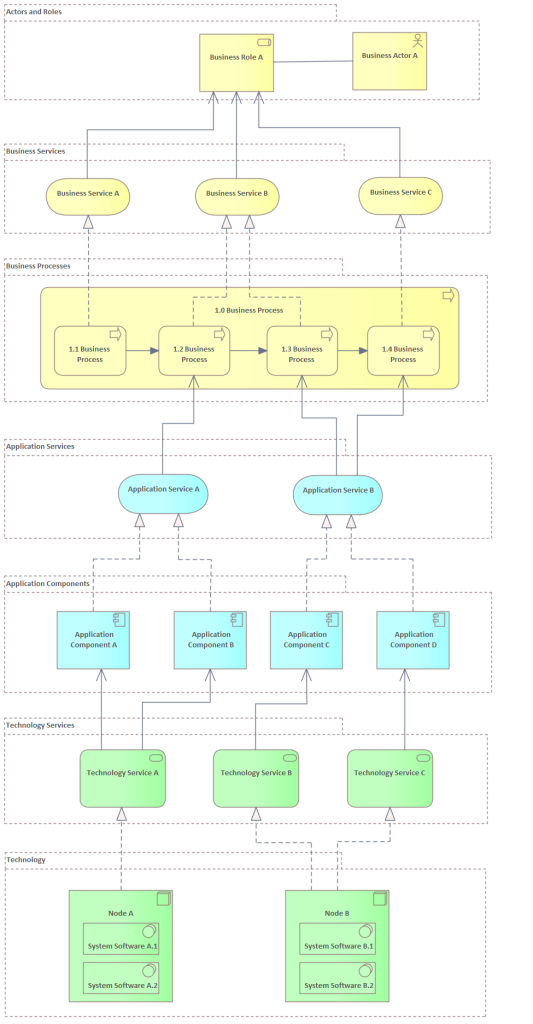
At its core, enterprise architecture (EA) is the discipline of aligning business and IT to achieve long-term transformation. It ensures that people, processes, and technology work in harmony. When organizations ask, “what is an enterprise architecture?”, the answer lies in understanding the enterprise architecture layers—the building blocks that structure how enterprises plan, model, and execute their strategy.
Understanding Enterprise Architecture Layers and Domains
Enterprise Architecture is typically divided into four primary domains (often called the enterprise architecture layers):
Business Architecture Layer
Captures strategy, value streams, capabilities, and processes.
Application Architecture Layer
Defines the systems, services, and integrations that support the business.
Data / Information Architecture Layer
Structures how data is modeled, governed, and shared across the enterprise.
Technology Architecture Layer
Details the infrastructure, platforms, and networks that power the applications and data.
Need help implementing Enterprise Architecture Best Practices?
Talk to our experts for tailored architecture consulting and hands-on guidance with Sparx EA.
Why Enterprise Architecture Layers Matter
- Traceability – Connects business goals to IT execution.
- Agility – Helps enterprises adapt to change while maintaining structure.
- Governance – Establishes standards for compliance and risk management.
- Value Realization – Provides a measurable way to demonstrate ROI from architecture efforts.
Sparx Enterprise Architect Tool: Modeling Across Layers
The Sparx Enterprise Architecture tool provides complete support for modeling and managing these layers:
Business Layer – Strategy & Process Models
- Use Sparx Enterprise Architecture modeling to capture business capabilities, value chains, and processes.
- Model with BPMN for process flows and connect them to enterprise outcomes.
Application Layer – Portfolio & Integration
- With the Sparx architecture tool, manage application portfolios and dependencies.
- Show interactions and services between systems to reduce redundancy.
Data Layer – Information & Governance
- Use Sparx Enterprise Architecture models to represent logical and physical data structures.
- Connect to databases and reverse-engineer schemas to keep models in sync.
Technology Layer – Platforms & Infrastructure
- Model infrastructure stacks, servers, and cloud platforms.
- Apply Sparx TOGAF modeling and technology catalogs for governance and planning.
Sparx ArchiMate Modeling and TOGAF Support
The Sparx enterprise architecture tool comes with full support for industry frameworks:
- Sparx ArchiMate modeling – Visualize and connect business, application, data, and technology domains.
- Sparx TOGAF modeling – Apply TOGAF’s ADM cycle for strategy, baseline, target states, and roadmaps.
This ensures enterprises not only model their enterprise architecture layers, but also manage them according to industry best practices.
Benefits of Sparx Enterprise Architecture Modeling Across Layers
- Holistic Enterprise View – See connections across all four enterprise architecture domains.
- Stakeholder Engagement – Prolaborate dashboards make complex models easy for executives.
- Integration Ready – Connects with Jira, ServiceNow, Azure DevOps, and more.
- Scalability – Supports large-scale transformation initiatives in finance, government, telecom, and manufacturing.
Get role-based training designed to match your EA use cases—from beginner to advanced.
Turning Enterprise Architecture Layers into Action
The enterprise architecture layers are the foundation for transformation. With the Sparx Enterprise Architecture tool, organizations can model business, application, data, and technology domains in a single repository. Through Sparx ArchiMate modeling, Sparx TOGAF modeling, and integrated dashboards, enterprises gain the clarity and governance needed to move from vision to execution.
Want to upskill your team in Sparx EA?


