
The case study highlights how enterprise architecture and associated tools help water management companies address challenges, improve operations, and enable business transformation with inputs from Cameron Brown, Enterprise Architect & Solution Lead and Ramsay Millar Enterprise Business Architect & Business Modeling Expert at Integrate IT.
A water organization in Saudi Arabia faced challenges like increasing demand for water, network construction, regulations, water quality and scarcity. They needed to maintain digital network security, water supply reliability, control data access, visually document as-commissioned assets, support engineering reviews and investment planning.
In our Case Study, we outline a journey leveraging Enterprise Architecture (EA) method and tools from Sparx Systems to realise a digital twin architecture to meet emerging challenges of supporting business and IT leaders faced with the complex challenge of evolving complex operating models. These challenges are the responsibility of CIOs and enterprise architects to transform their technology landscape in line with changing business architectures to realize a holistic view of water ecosystems which combines physical assets with digital devices.
IDRICA was engaged to lead the project team. They selected Sparx Systems to create a digital twin of the water company. A team of Water Engineers, Industry Specialists, and Enterprise Architects captured, generated, and linked architectural information.
Water organizations face challenges in re-engineering business models, realizing cost savings, developing new products/services, and improving customer experience. They need to embrace new technologies to optimize operations and improve financial performance while managing water resources. There’s also a growing amount of data from smart water networks, digital sensors, customers, and external sources.
Increasingly, all major industries are adopting emerging technologies, such as the Internet of Things (IoT), artificial intelligence (AI), machine learning (ML), cloud computing, and more, to enhance their transformation efforts. However, it takes careful and methodical Enterprise Architecture Development to deliver products/services to accommodate ever-changing consumer demands, regulations and environments.
Enterprise Architecture (EA), supported by simple and effective methods and tools, provide a factual basis for digital innovation, knowledge management, and adaptive modelling of alternative solutions. For example, it enables water sector organizations to identify new opportunities in the context of the business as well as identify new digital products to optimize existing business practices.
Additionally, well-formed Enterprise Architecture Development supports organized development and implementation of digital strategy and is key to its successful execution. When executed properly, enterprise architecture helps water utilities understand — and have a big picture view over — the whole physical plant and digital structure of the business operating model. By aligning operational strategy with the technology needed to meet enterprise-level goals, EA provides water companies/utilities visibility and direction for data-driven decision making.
The TOGAF Architecture Development Method (ADM) and ArchiMate were adopted, to ensure all architecture layers are completed and aligned, with the realities of current business operating models, IT and budgets. Finding the right balance between the strategic business goals and tactical focus will be key to early success.
The cloud-based toolset from Sparx Systems including Enterprise Architect, Prolaborate, and PCS was purchased due to low cost of entry, security, and flexible choices for cloud deployment strategies. Enterprise Architect EA tool is an obvious front runner with more than one million users globally.
Adopting Sparx Systems Cloud Suite, a modern data-driven EA tool, made it simple to inventory IT data, build and track data relationships, collaborate, run analysis to deliver real time insights that matter to business and technology leaders. Using Sparx Systems Cloud Suite for managing and optimizing IT, Water Management organizations can reduce costs, mitigate risks, and become more agile. No other skilled practice other than enterprise architecture even comes close to successfully achieving the mammoth task of digital transformation in the Water industry. Sparx Systems Cloud Suite has the capability to integrate with multiple data sources to capture, document and maintain views of the organizations capabilities, processes, data, IT infrastructure, and operational assets in real-time.
Sparx Systems Enterprise Architect coupled with Prolaborate was very effective due to its open data integration that captures real-time generated architecture as a single source of truth repository to enable business leads, architects, and stakeholders to collaborate across the complete enterprise. Prolaborate simplifies information sharing using strategic reporting, precise visual models representing timely observations via curated views. Distributed access means process workflows are optimized by analysts. By using re-engineered business process models, stakeholders can drive their own analysis.
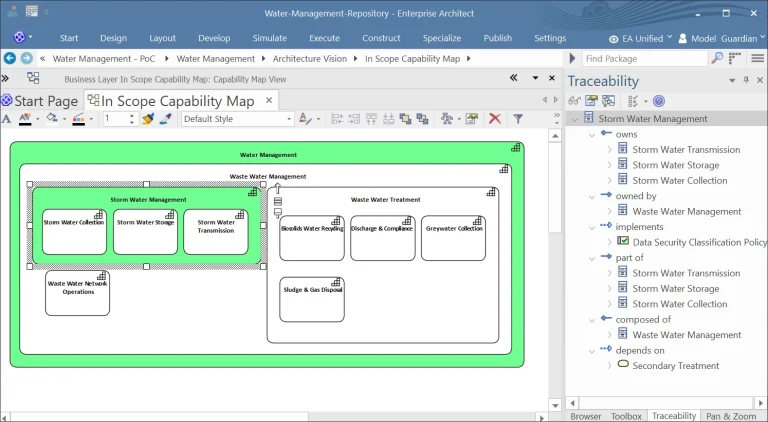
Project Screenshot of Enterprise Architect tool viewing the Water Management Repository to reveal Traceability from Capabilities to Processes
Idrica chose to bring in a Sparx Expert to mentor, train and guide the EA project. Throwing software and AI at a solution without empowering your people is unlikely to ensure long term success. Training empowers teams by equipping them with the necessary skills, knowledge, and confidence to perform their roles effectively, collaborate efficiently, and contribute to the overall success of the organization. It fosters a sense of ownership, encourages innovation, and boosts morale, leading to increased productivity and a more engaged workforce. Our approach was to deliver custom hands-on tool training using Water examples sources from the Water business stakeholders and operating model to build confidence and prove the value of the solution.
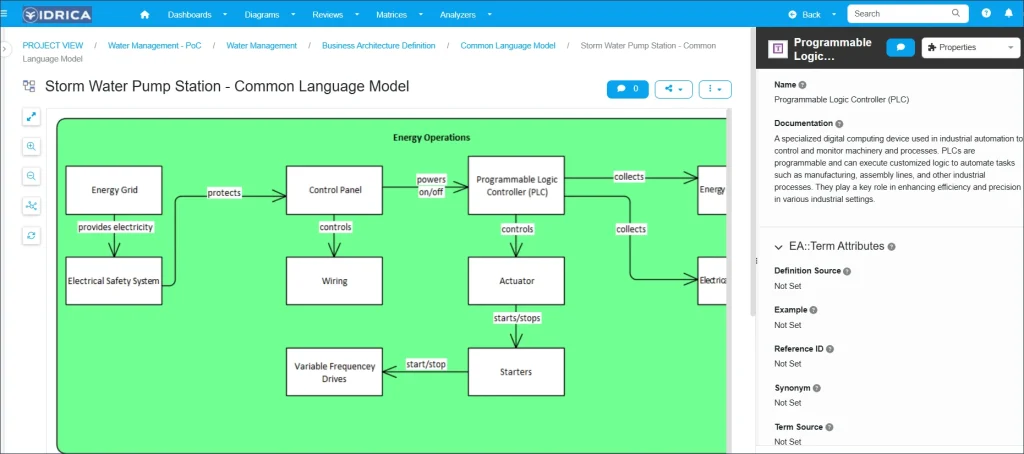
A common language was developed to model and define terms and semantics. A common language model refers to a method of structuring and defining business vocabulary using a standardized approach where the focus is on clearly defining key business terms and their associated terms using a structured “concept model” to ensure consistent communication and understanding across the organization. Adopting this discipline allowed the creation of a capability business glossaries early in the project to foster sharing of terms and associated knowledge related to these terms and definitions. This made architecture development more precise and fact-based.
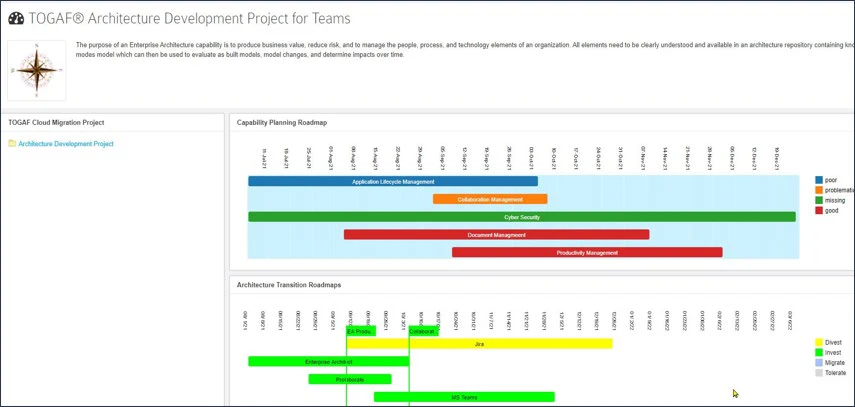
Prolaborate Capability Roadmap Dashboards linked big-picture business strategy with daily work, so everyone could see how investment decisions supported business goals and objectives. Project screen shot from Prolaborate of the capability roadmap dashboard to bring business stakeholders on to the same page regarding IT investment planning.
Business Process Management (BPM) is a structured approach to improving an organization’s workflows and operations. It involves analysing, designing, implementing, monitoring, and optimizing business processes to achieve strategic goals more efficiently and effectively. Our case study delivered Process execution tracing from Value Stream to Process Cooperation to Process Scope and include options for Process Swim-lanes following the Six Sigma practice and methods. The below image of Process Driven Execution Dashboard in Prolaborate to provide line of visibility from board room to process execution. These customizable Dashboards allow Stakeholder views to be presented all in one place by security group.
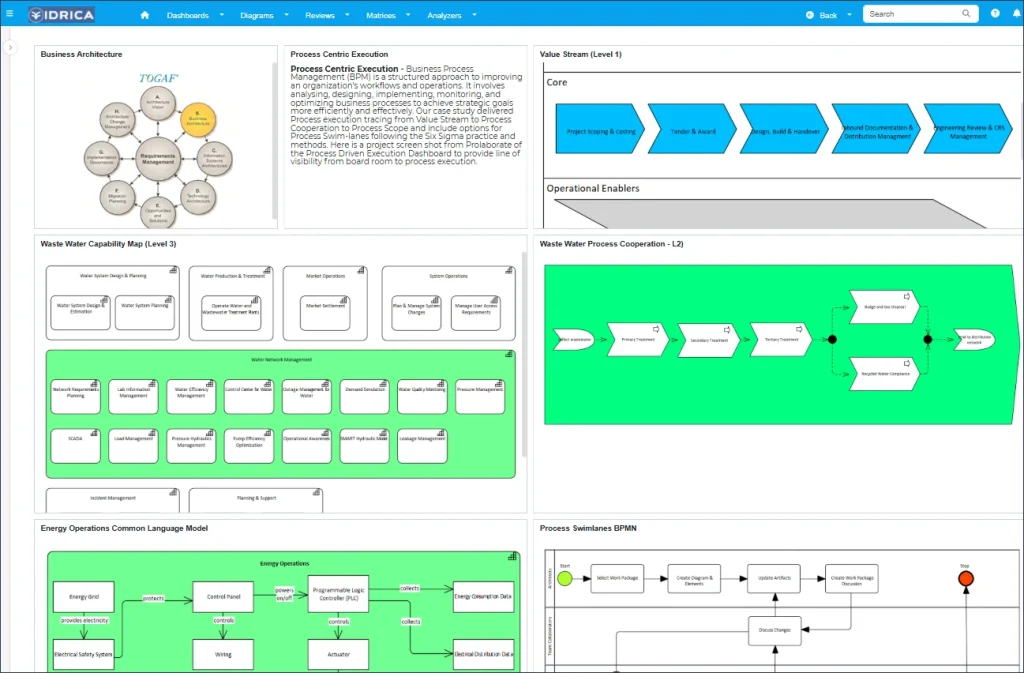
Project screenshot from Prolaborate’s Process Driven Execution Dashboard to provide line of visibility from broad room to process execution.
Is a comprehensive process that oversees the entire lifespan of a software application, from its initial conception to its eventual retirement or replacement. It encompasses various stages, including planning, development, testing, deployment, and maintenance, and involves the integration of people, processes, and tools to ensure efficient and effective management of the application throughout its lifecycle. This project included cataloguing hundreds of Software Applications and related data stores, identifying duplicate functionality and sources of truth to support scenario-based application rationalization.
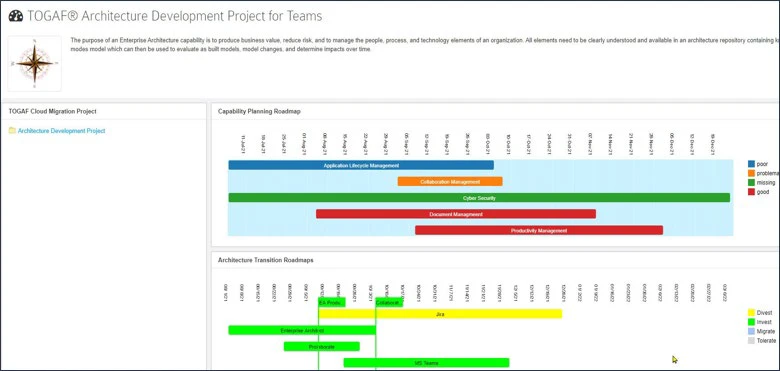
Project screenshot from Prolaborate Dashboard of the Application Rationalization Roadmap.
Organizations that try to implement new technologies such as AI reporting, within traditional IT architectures strain under the demands of evolving market and customer requirements. The same goes for the water utilities sector. The water industry is at a turning point that requires a change in the way IT investments are planned and executed. Organizations that continue with a business-as-usual IT strategy will paint themselves into a corner, unable to benefit from the more agile technologies that empower today’s thriving enterprise.
Facing increasing maintenance and operational costs, population driven water network expansion, water companies are now more focused on operational efficiency and saving money. Organizations must adopt a responsive and adaptive architecture supported by modern EA methods and tools along with agile delivery approaches better suited to handle rapidly evolving business needs and environmental factors.
Modern Enterprise Architecture practices and tools offer significant value for water and utility companies by improving innovation, reusability, stability, and standardization. Sparx EA also helps improve asset management, business processes, change management, resource management, and especially interoperability and integration.
Generated models ensured that every physical asset and related Internet of Things (IoT) software device were visualized, traceable, secured, and delivered metrics using real-time hardware lifecycle management, custody tracking, and actionable insights, all in one centralized hardware tracking platform that was reflected using data integrations to avoid a single tool point of failure. Operational systems data was collected without the need to change tools. The cloud-based toolset from Sparx Systems, uses an open API architecture and plays well with all the leading Water industry IT solutions.
The Open API integration enables seamless integration from Configuration (CMDB) and Asset Management (AM) and other platforms to support generation of views and models.
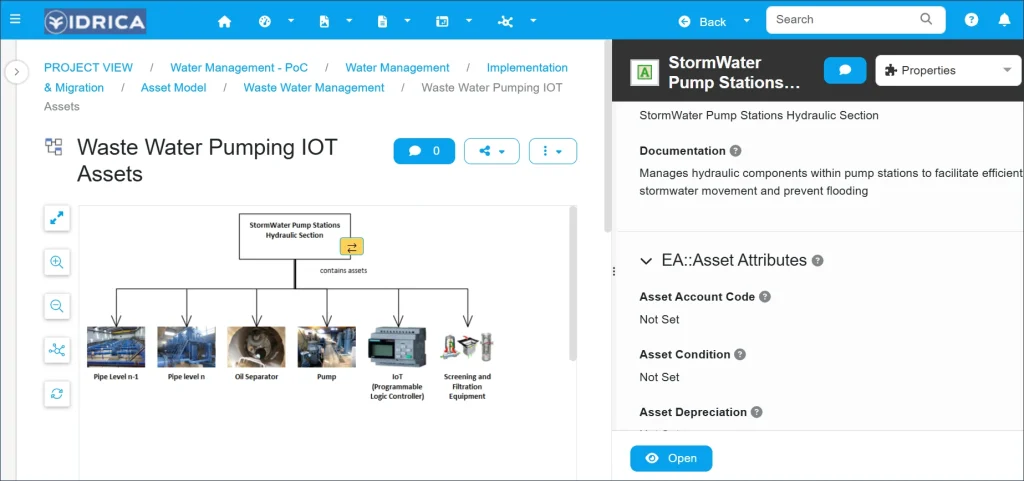
Project screenshot from Prolaborate an Engineering approved Storm Water Pumping Station plan including associated IoT devices.
• Empowering Teams: Training was provided to equip teams with the necessary skills and knowledge.
• Common Language Model: A standardized approach to defining business vocabulary.
• Capability-based Planning & Execution: Prolaborate dashboards link business strategy with daily work.
• Data-Driven Enterprise Architecture: Implementation of new technologies such as AI.
• AI Analytics: Operational data was used for business insights through dashboards.
• Common Language Model: Consistent communication across the enterprise.
• Collaborative Stakeholder Review: Web-based collaboration for project teams.
• Consistent Documentation: Custom web-based dashboards provided standardized reports.
• Data Discovery and Collaboration: Support for innovation and data-driven initiatives.
• Easy Access: Easy access to Prolaborate dashboards for stakeholders.
• Effective Roadmaps: Capability-driven roadmaps linked strategy with daily work.
• Engineering Governance & Compliance: Policy reviews for site plans.
• Fact-based Single Source of Truth: Knowledge management repository.
• Immediate Traceability: Visual models showing traceability.
• Low Cost of Entry: Cloud-based toolset with flexible deployment strategies.
• Rapid Onboarding: Training of new hires using consistent documentation.
• Reusing TOGAF and Archimate Framework: Leveraging standard diagram notation.
Submit Your Request and We’ll Promptly Send a Payment link or Invoice.