
What is Enterprise Architecture Strategy?
An enterprise architecture strategy is the structured approach organizations use to ensure technology, processes, and people align with business goals. Instead of being a back-office activity, EA as a strategy enables leadership teams to shape investments, reduce risks, and create sustainable growth.
In short, it is the strategic architecture that translates business strategy into executable technology and process outcomes.
To make this practical, many teams adopt Sparx Enterprise Architecture practices directly in Enterprise Architect. This allows enterprise architect ArchiMate modeling alongside UML and BPMN, so strategy can be expressed consistently across viewpoints without losing traceability.
Hands-On, framework-aligned training by certified Sparx EA experts using the Sparx Systems Architecture Platform.
Why Organizations Need an Architecture Strategy?
The enterprises face multiple challenges:
- Complex IT Portfolios with redundant systems.
- Pressures to comply with regulations and industry standards.
- Fast-changing digital transformation demands.
A well-defined architecture strategy provides:
- Clarity – How business strategy and enterprise architecture connect.
- Governance – Standards for sustainable decision-making.
- Agility – Flexible roadmaps for evolving conditions.
- Value Realization – Demonstrating ROI from enterprise initiatives.
When implemented with Sparx Enterprise Architecture capabilities, these outcomes become measurable. Teams can baseline current-state, plan target-state, and use Sparx Enterprise Architecture features to trace decisions across domains and time.
Core Components of a Strategic Architecture Approach
With Sparx Systems, these principles become actionable:
- Vision & Guiding Principles – Define the role of EA as a strategy in the organization.
- Business–IT Alignment – Ensure business strategy and enterprise architecture are traceable.
- Capability & Roadmaps – Show where to invest and when.
- Governance & Standards – Keep execution consistent.
- Measurement & Outcomes – Demonstrate success with metrics and dashboards.

In Sparx Enterprise Architect, organizations can choose the method that fits: Sparx EA TOGAF for governance and architecture development, Sparx EA ArchiMate for layered viewpoints and motivation/strategy mapping, or Sparx EA Zachman for a taxonomy-driven inventory—each fully traceable to portfolios, solutions, and delivery plans.
Best Practices for Enterprise Architecture Strategy
Here are the best practices that Sparx Systems enables:
- Start with Business Value – Map capabilities before modeling technology.
- Engage Stakeholders – Use visual dashboards for CXOs and managers.
- Make It Iterative – Update strategic architecture as the business changes.
- Integrate Tools & Processes – Link EA to Jira, ServiceNow, and DevOps pipelines.
- Track & Communicate Outcomes – Use scorecards and KPIs to prove value.
To ensure adoption, publish strategic views through a Sparx EA stakeholder portal powered by Prolaborate. Curated perspectives and Sparx Prolaborate stakeholder dashboards let executives, product owners, and architects consume insights quickly without need the thick-client tool.
How Sparx Systems Architecture Platform Enables Enterprise Architecture Strategy?
Sparx Enterprise Architect
- Models strategic architecture using TOGAF, ArchiMate, and UML. Supports structured enterprise architect ArchiMate modeling with motivations, capabilities, and roadmaps.
- Maps business strategy and enterprise architecture across BAIT layers.
- Provides traceability from vision to execution.
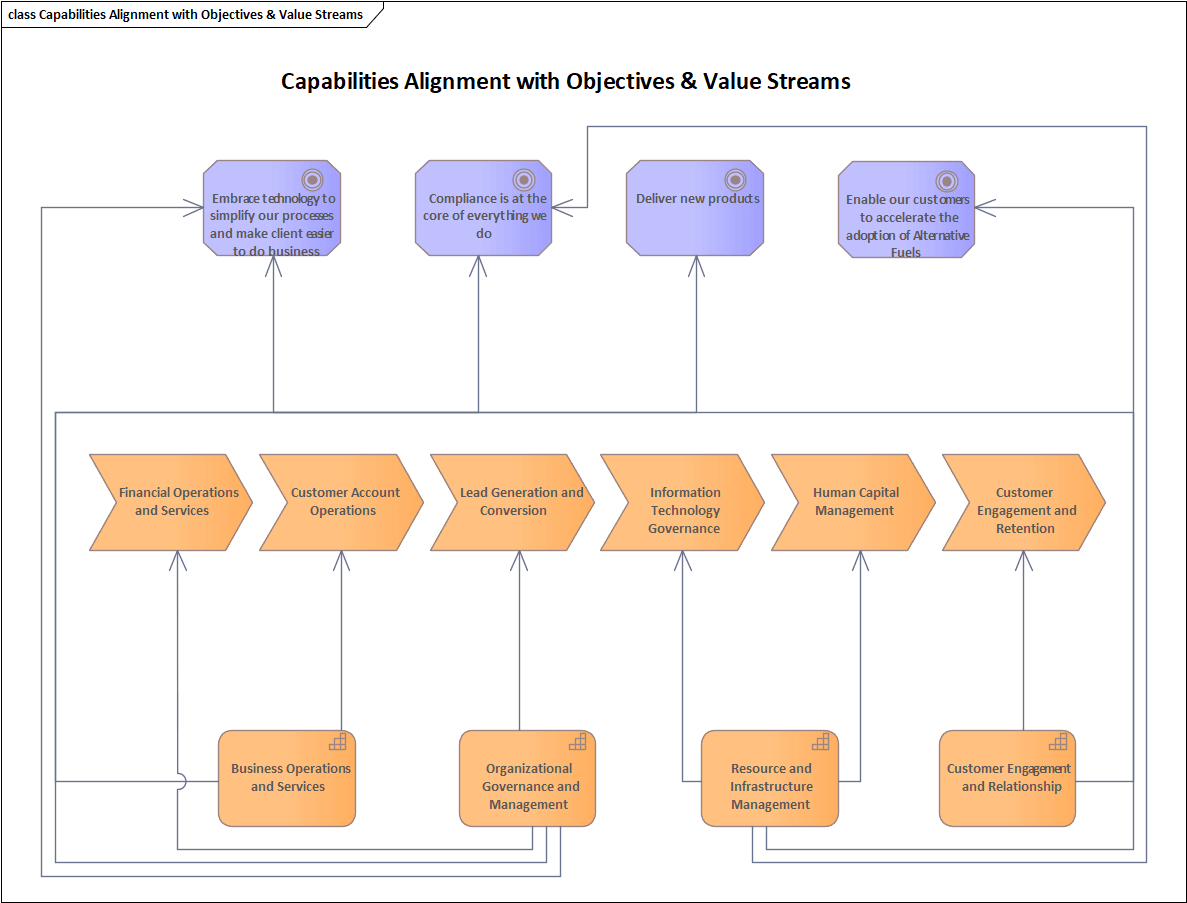
Beyond frameworks, the platform’s Sparx Enterprise Architecture features such as matrix views, gap analysis, heatmaps, and impact analysis, allow consistent decisions and repeatable governance.
Sparx Pro Cloud Server
- Delivers collaboration across distributed teams.
- Integrates with project and ITSM tools.
- Ensures strategy is live, not static.
Sparx Prolaborate
- Builds executive dashboards to visualize progress.
- Enables guided stakeholder views.
- Supports governance workflows and lightweight approvals.
Use Sparx Prolaborate to publish a Sparx EA stakeholder portal that provides secure, role-based access to roadmaps, portfolios, and dependency views. Extend this with Sparx Prolaborate stakeholder dashboards for capability maturity, risk, and investment alignment.
Benefits of Adopting an Enterprise Architecture Strategy with Sparx Systems
- Clear business–IT alignment.
- Better decision-making with dashboards and metrics.
- Reduced portfolio costs by eliminating redundancy.
- Future-proof transformation roadmaps.
These results compound when using Sparx Enterprise Architecture capabilities such as repository-wide traceability, variant management, and guided reviews along with framework support for Sparx EA TOGAF, Sparx EA ArchiMate, and Sparx EA Zachman to align method with organization culture.
Start modeling with built-in TOGAF & ArchiMate support, traceability and collaboration using the Sparx Systems Architecture Platform
Conclusion: Enterprise Architecture Strategy as a Competitive Advantage
A robust enterprise architecture strategy ensures that transformation isn’t left to chance. By combining business strategy and enterprise architecture, and supporting it with the Sparx Systems Architecture Platform, organizations can create a living, evolving framework that turns strategy into execution.
Adopting Sparx Enterprise Architecture with Prolaborate makes that strategy visible and governable at scale—through curated views, Sparx Prolaborate stakeholder dashboards, and a Sparx EA stakeholder portal that keeps leaders engaged and teams aligned.


